In true Make Noise fashion, this video dives into the subtle art of using VCAs not just for loudness, but for sculpting silence and dynamic movement in modular patches. Pete, filling in from the Make Noise Instagram channel, walks through three distinctive approaches: a Binary Zone-inspired Maths + TEMPI patch, a minimal-cable 0-Coast + 0-CTRL setup, and a crossfading, balanced modulation trick with X-PAN and Ch.Svr. The result? A masterclass in how voltage control and clever routing can breathe life—and rests—into your system. If you think VCAs are just for volume, this one’s a gentle nudge to think again.
Introducing Silence: The VCA as a Rest Machine
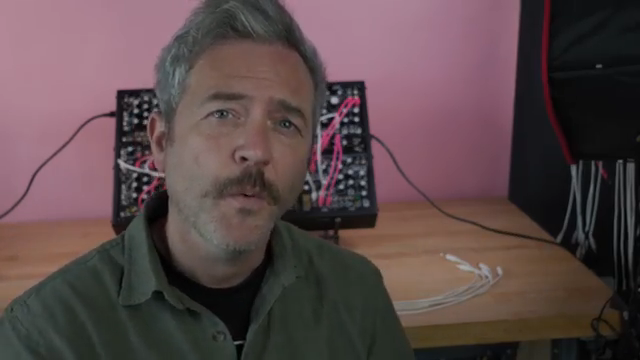
Pete opens the video with a meditation on peace and quiet, both in life and in modular synthesis. Drawing a parallel between restorative downtime and sonic rests, he sets the stage for a trio of patches that use voltage controlled amplifiers to carve out space in a patch. The underlying question: how can silence be woven into a modular system, and what modules lend themselves to this task?
He quickly champions the oft-repeated modular mantra that you can never have too many VCAs—a sentiment that will ring true for anyone who’s ever run out mid-patch. The three patches previewed each use a different Make Noise module as the heart of their VCA action: Maths, 0-CTRL, and X-PAN. The first two focus on inserting rests and dynamic gaps, while the third explores modulation without explicit silence. This sets up a practical exploration of how VCAs can be more than just volume knobs—they’re tools for musical punctuation.
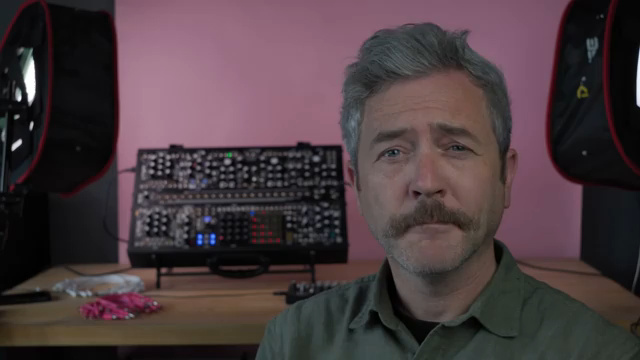
"Some people say you can never have enough VCA's, and these people are correct."
© Screenshot/Quote: Maken0Isemusic (YouTube)
Binary Zone Redux: Maths + TEMPI Tribute
"Experiment with different multiplication and division settings on Tempy, as well as different mix settings in Maths to achieve a huge variety of results."
© Screenshot/Quote: Maken0Isemusic (YouTube)
The first patch pays homage to the Blacet Binary Zone, a rare and now out-of-production module known for its clock divider and polarizing mixer combo. Pete reconstructs its spirit using TEMPI as a divider and Maths as a mixer, showing how these two modules can interact to generate stepped control voltages and dynamic modulation.
He patches a Spectraphon oscillator into a DXG channel, first letting us hear it unmodulated. Then, by triggering Maths with TEMPI and routing variable outputs to the DXG’s CV input, he introduces dynamic movement. The patch evolves as additional TEMPI outputs are sent to different Maths channels, each set with positive or negative weighting to influence the fall time and thus the envelope shape.
Experimentation is encouraged: tweaking TEMPI’s multiplication/division and Maths’ mix settings yields a wide range of results. The key takeaway is that this approach injects life into a patch, especially when the resulting modulation is sent to a VCA or low pass gate. The demonstration ends with the patch in a larger context, showing how these techniques can animate a full system.
Minimal Moves: The One-Cable 0-Coast + 0-CTRL Patch
Next up is a streamlined patch using 0-Coast and 0-CTRL, focusing on envelope dynamics with a single crucial cable. Pete admits that, as with all modular, there’s never truly just one cable—but here, the magic lies in connecting the pressure CV output of 0-CTRL to the strength CV input of 0-Coast.
With the interrupt control switched off, this setup allows for uninterrupted sequencing while still enabling touch control over envelope strength. Adjusting the strength control and experimenting with echo effects, Pete demonstrates how subtle variations in CV can create nuanced dynamic shifts. The result is a patch that’s both simple and expressive, highlighting how minimal connections can yield rich modulation.
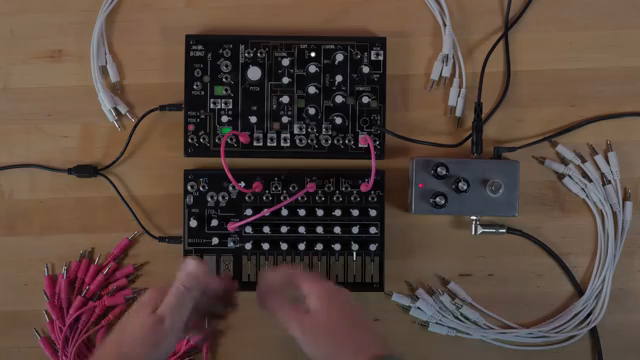
"Turning it off allows us to touch the pads and have the sequence continue uninterrupted."
© Screenshot/Quote: Maken0Isemusic (YouTube)
Crossfaded Complexity: X-PAN and Ch.Svr as Balanced Modulator
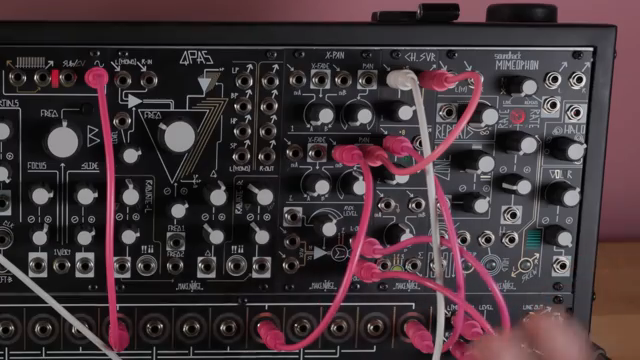
"As I increase the crossfade position, we'll hear balanced modulation."
© Screenshot/Quote: Maken0Isemusic (YouTube)
The final patch is a nod to Grant Richter’s X-Mix, repurposing X-PAN and Ch.Svr to achieve balanced modulation via crossfading. Pete walks through two variations: the first mimics the X-Mix’s phase inversion trick, using a Malt to split a sine wave from Spectraphon, sending one copy through Ch.Svr for inversion and then into X-PAN’s crossfade inputs. By adjusting the crossfade, the two signals cancel, setting the stage for modulation.
A second sine wave, patched through an attenuator, modulates the crossfade position. Pete is careful to avoid distortion by attenuating the modulator, and demonstrates how the pan control on X-PAN doubles as a VCA when only one output is used. Adjusting oscillator frequencies yields evolving harmonic content, and the patch is shown both in isolation and as part of a more complex setup.
The alternate approach involves audio-rate modulation of the pan control, patching both X-PAN outputs to the monitor and using the crossfade position as a VCA. This method offers another flavour of balanced modulation, again with the possibility for dynamic volume control. Both variations underscore the flexibility of X-PAN and Ch.Svr in creative modulation roles.
Philosophy of Silence: VCAs and the Texture of Sound
Throughout the video, Pete returns to the idea that silence and dynamic variation are as vital as sound itself in modular synthesis. By using VCAs not just for amplitude, but for introducing rests and nuanced modulation, patches become more organic and alive.
The closing thoughts reinforce the notion that creative VCA use is foundational to textured, expressive patches. Whether you’re sculpting silence, animating envelopes, or crossfading complex modulations, the humble VCA is at the heart of it all—a point that Make Noise’s exploratory ethos makes abundantly clear.
This article is also available in German. Read it here: https://synthmagazin.at/maken0ise-stille-patchen-und-dynamik-gestalten-drei-vca-workouts/
Watch on YouTube:
Latest articles
Watch on YouTube:
Visit the channel:
https://www.youtube.com/MAKEN0ISEMUSIC
https://www.youtube.com/MAKEN0ISEMUSIC
Links from MAKEN0ISEMUSIC:
website: https://www.makenoisemusic.com
instagram: https://www.instagram.com/makenoisemusic
twitter: https://twitter.com/makenoisemusic
facebook: https://www.facebook.com/makenoiseco
Sponsored links:
If you purchase via these links, we may earn a small commission – at no extra cost to you. The link opens an Amazon keyword search, and results may vary depending on availability.
0-Coast
🔗 Check price on Amazon
🔗 Check price on Amazon
0-CTRL
🔗 Check price on Amazon
🔗 Check price on Amazon
Ch.Svr
🔗 Check price on Amazon
🔗 Check price on Amazon
Maths
🔗 Check price on Amazon
🔗 Check price on Amazon
Tempi
🔗 Check price on Amazon
🔗 Check price on Amazon
X-PAN
🔗 Check price on Amazon
🔗 Check price on Amazon