Make Noise, the Asheville-based champions of modular experimentation, take us on a deep dive into the Spectraphon—a resynthesizer module that promises to redefine how we sculpt and manipulate sound in Eurorack. In this inaugural ‘ReSynthesizer Patch of the Week,’ the Make Noise team unpacks the Spectraphon’s unique approach to resynthesis, contrasting it with their Morphagene and highlighting the creative possibilities unlocked by spectral amplitude modulation. Expect a patch-oriented exploration brimming with harmonic sleights of hand, filtering tricks, and a workflow that invites both precision and happy accidents.

14. November 2024
MILES
Make Noise Spectraphon: Reimagining Resynthesis in Eurorack
Make Noise Cupass, Make Noise DXG, Make Noise Maths, Make Noise Morphagene, Make Noise Spectraphon, Make Noise X-Pan
Spectraphon: A New Angle on Resynthesis
The video opens with Make Noise positioning the Spectraphon as a resynthesizer that doesn’t just recreate sounds, but reimagines them. Unlike the Morphagene, which is described as recreating audio literally, the Spectraphon operates more figuratively—taking input material and transforming it into something new through spectral analysis and synthesis. This conceptual distinction sets the tone for the module’s role in a rack: it’s not about faithful reproduction, but about creative reinterpretation.
To ground this idea, the patch setup is kept simple, following a basic resynthesis patch from the manual. Outputs from the Morphagene are multed to the DXG and also sent to the Spectraphon’s input. The even and odd outputs from the Spectraphon are panned and mixed via the X-Pan, then routed back through the DXG and out to the monitor. This signal path allows for direct comparison and blending of the Morphagene’s and Spectraphon’s outputs, with the DXG providing level control and mild filtering to tame any harshness.

"The Morphagene recreates sounds literally while the Spectraphon reimagines them figuratively."
© Screenshot/Quote: Maken0Isemusic (YouTube)
Pitch, Harmonics, and Spectral Amplitude Modulation
"The Spectraphon's pitch control sets the core pitch of its oscillator. Everything you hear at the output will be harmonic multiples of that core pitch."
© Screenshot/Quote: Maken0Isemusic (YouTube)
A core focus of the Spectraphon is its distinctive approach to pitch and harmonics, particularly in SAM (Spectral Amplitude Modulation) mode. Unlike a standard oscillator, the Spectraphon’s pitch control sets the core frequency, with all output harmonics derived from this base. However, the core pitch itself may not always be present in the output, leading to timbres that can sound strikingly different from traditional synthesis.
The video contrasts this with the Morphagene, where the very speed parameter determines playback pitch, but the actual note depends on the reel’s content. In Spectraphon, everything is referenced to the set core frequency, and harmonic motion is achieved by resynthesizing spectral content as multiples of this frequency. This can create the illusion of pitch shifting, even when the fundamental remains constant.
The slide parameter is highlighted as a key control, determining which frequency the Spectraphon listens for and treats as the fundamental. Turning slide shifts the harmonic series being resynthesized, while adjusting pitch moves the entire output up or down. The result is a flexible harmonic landscape, with the possibility of producing sounds dominated by upper harmonics—sometimes bordering on the shrill, but always rooted in the spectral relationship to the core frequency.
Parameter Manipulation: Shaping Harmonics and Structure
The demonstration moves into how tweaking various parameters directly sculpts the harmonic content and overall sound structure. By monitoring both the sine output (the core frequency) and the even/odd outputs, it becomes clear that the resynthesized signal can be almost entirely devoid of the fundamental, resulting in timbres rarely found in nature.
A series of five variables are identified as shaping the resynthesized result: Morphagene’s very speed, Morphagene’s slide, pre-filtering with the Cupass, Spectraphon’s slide, and Spectraphon’s pitch. Each of these acts simultaneously, and modulating any one will alter the output. The video underscores how this interconnectedness allows for a broad palette of sounds, from tightly focused harmonic structures to wide, shifting spectra.
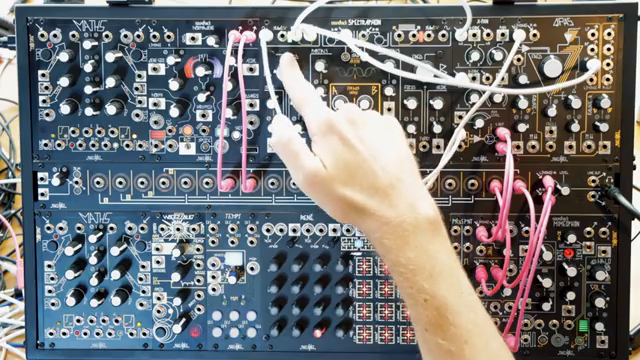
"That's five different steps from original sound to audible re-synthesis, all of which occur simultaneously and each of which affects what we ultimately hear."
© Screenshot/Quote: Maken0Isemusic (YouTube)
Workflows: Filtering, Arrays, and Creative Modulation
Beyond the core resynthesis, the video explores workflow enhancements such as integrating filtering before the Spectraphon’s input. Using the Cupass for high-pass or bandpass filtering, users can select which frequencies are allowed into the resynthesizer, further refining the spectral material available for transformation.
The concept of arrays is introduced as a means of capturing and sequencing different spectral snapshots. Arrays created from the same source material can be modulated or sequenced with shapes from Maths, offering a flexible approach to sound design. The video hints at even deeper possibilities—such as modulating arrays with different shapes—leaving the door open for further exploration in future patches.
This article is also available in German. Read it here: https://synthmagazin.at/make-noise-spectraphon-resynthese-neu-gedacht-im-eurorack/
Watch on YouTube:
Latest articles
Watch on YouTube:
Visit the channel:
https://www.youtube.com/MAKEN0ISEMUSIC
https://www.youtube.com/MAKEN0ISEMUSIC
Links from MAKEN0ISEMUSIC:
website: https://www.makenoisemusic.com
instagram: https://www.instagram.com/makenoisemusic
twitter: https://twitter.com/makenoisemusic
facebook: https://www.facebook.com/makenoiseco
Sponsored links:
If you purchase via these links, we may earn a small commission – at no extra cost to you. The link opens an Amazon keyword search, and results may vary depending on availability.
Make Noise Cupass
🔗 Check price on Amazon
🔗 Check price on Amazon
Make Noise DXG
🔗 Check price on Amazon
🔗 Check price on Amazon
Make Noise Maths
🔗 Check price on Amazon
🔗 Check price on Amazon
Make Noise Morphagene
🔗 Check price on Amazon
🔗 Check price on Amazon
Make Noise Spectraphon
🔗 Check price on Amazon
🔗 Check price on Amazon
Make Noise X-Pan
🔗 Check price on Amazon
🔗 Check price on Amazon