Make Noise, the Asheville-based champions of modular oddity, return with PoliMATHS—a bold eight-channel CV and audio event generator designed to supercharge the New Universal Synthesizer System (NUSS) or any Eurorack setup. This official walkthrough dives into how PoliMATHS distills complex function generation into a single set of controls, unleashing a patchable playground of envelopes, oscillations, and polyphonic tricks. If you’ve ever wished your Maths could multiply, or your function generators could talk to each other behind the rack, this video is your invitation to a new world of modular choreography. Let’s see how Make Noise’s latest creation rewires the rules of polyphonic patching.

2. October 2025
MILES
Make Noise PoliMATHS: Eight Channels of Function-Driven Polyphony for Modular Explorers
From One, Many: PoliMATHS Joins the Modular Fold
PoliMATHS enters the scene as an eight-channel CV and audio event generator, purpose-built for Make Noise’s New Universal Synthesizer System (NUSS) but equally at home in any Eurorack modular environment. The video wastes no time showing how this module can serve as the nerve centre for multi-channel patches, with each of its eight outputs ready to drive complex modulation or audio events. The design philosophy is clear: maximum polyphony, minimum menu-diving.
What sets PoliMATHS apart is its ability to generate intricate functions across all eight channels using a unified set of controls. This approach streamlines patching, especially for those who crave polyphonic textures or want to experiment with multi-layered modulation. The demonstration highlights the module’s role as a backbone for expansive modular rigs, where the challenge is often how to coordinate many voices without a tangle of cables and mismatched envelopes.
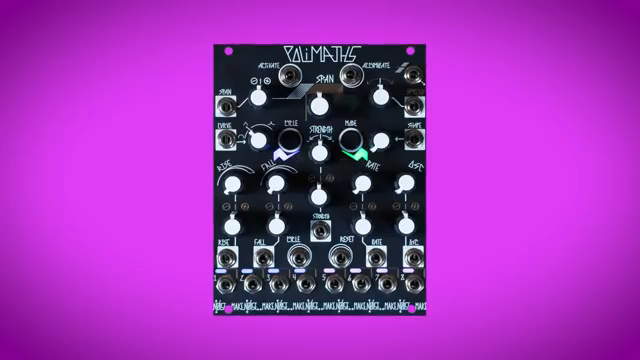
"Polymaths is the eight channel CV and audio event generator for the new universal synthesizer system or any Eurorack modular synthesizer."
© Screenshot/Quote: Maken0Isemusic (YouTube)
Rise, Fall, and Oscillate: The Heart of PoliMATHS
At its core, PoliMATHS combines two familiar building blocks: the Rise-Fall envelope with variable curve (a nod to classics like Maths and Function), and a variable-shape oscillation section. Each channel houses a triggered function generator, letting users sculpt the contour of their modulation or audio with precise control over rise, fall, and curve. The video demonstrates how these controls shape the length and character of each event, from snappy blips to languid swells.
The oscillation section adds another layer of versatility, capable of running at both low and audio rates. This means PoliMATHS can serve as a complex LFO array, a bank of audio-rate voices, or anything in between. With amplitude shaped by the envelope, and the option for tuned pitch via 1V/oct input, the module invites experimentation—whether you’re crafting evolving control voltages or stacking polyphonic audio events.
Modes of Operation: Channel Index, Round, and Parallel

"If a function is still active when the next is activated, then they overlap, useful for polyphonic patches."
© Screenshot/Quote: Maken0Isemusic (YouTube)
PoliMATHS isn’t just about stacking functions; it’s about how you activate and distribute them. The video explores three main operational modes: Channel Index, Round, and Parallel. In Channel Index mode, users can target individual channels directly—ideal for precise polyphonic triggering or sequenced modulation. The ‘span’ and ‘activate’ controls make it easy to select and fire off specific channels, while overlapping functions allow for rich, layered textures.
Round mode introduces a step-sequencer-like approach, cycling through channels with each gate received at the activate input. By adjusting the span parameter, users can control how many channels are skipped or included in each step, opening up a world of rhythmic and melodic patterns. Parallel mode, meanwhile, uses the activate input as a clock divider, distributing triggers across channels according to the span setting. This trio of modes turns PoliMATHS into a flexible engine for both predictable and generative multi-channel behaviour.
Spread and Dissemination: Modulation Across the Polyverse
A standout feature of PoliMATHS is its approach to modulation. Rather than treating all channels identically, the module offers ‘Spread’ and ‘Modulation Dissemination’ to introduce variation across its outputs. Parameters marked with gold attenuverters—rise, fall, strength, rate, and oscillation—can be spread across channels, letting users skew values to the left or right for evolving, asymmetric patterns. The video demonstrates how spreading the fall parameter, for example, creates longer envelopes on one side of the channel array, adding movement and complexity.
For even more nuanced control, Modulation Dissemination allows per-channel parameter modulation via CV inputs. When patched, these inputs override the spread behaviour, updating parameter values each time a channel is activated and holding them until the next cycle. This enables nonlinear, polyphonic modulation sequencing—ideal for those who want each voice to have its own evolving character within a larger patch.
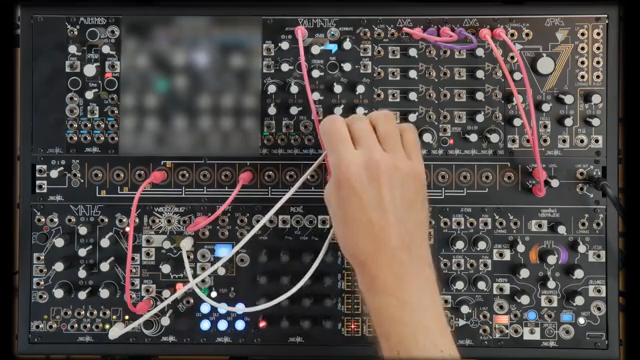
"This allows us to modulate parameters across channels in nonlinear ways, as well as create more purposeful modulation sequencing in a polyphonic manner."
© Screenshot/Quote: Maken0Isemusic (YouTube)
Chaining with QXG: Polyphonic Power, Streamlined
Integration is where PoliMATHS truly shines, especially when paired with the QXG Quad Stereo Gate. The video shows how the modules connect via a behind-the-scenes chain cable, instantly routing all eight channels of control from PoliMATHS to QXG’s amplitude and filtering stages. This eliminates the need for a nest of patch cables and creates a unified eight-channel back end for the NUSS ecosystem.
The result is a streamlined workflow for polyphonic patches, with each positive-going function from PoliMATHS opening a corresponding QXG channel to create notes or events. The stereo spread and individual outputs on QXG further enhance spatial possibilities, while the shared NUSS concepts—like channel index and span—ensure that future modules will slot seamlessly into this polyphonic architecture. For those seeking a modular system that can handle complex, multi-voice arrangements without the usual headaches, this pairing offers a compelling solution.
This article is also available in German. Read it here: https://synthmagazin.at/make-noise-polimaths-achtkanalige-funktionspolyphonie-fuer-modular-fans/
Watch on YouTube:
Latest articles
Watch on YouTube:
Visit the channel:
https://www.youtube.com/MAKEN0ISEMUSIC
https://www.youtube.com/MAKEN0ISEMUSIC
Links from MAKEN0ISEMUSIC:
website: https://www.makenoisemusic.com
instagram: https://www.instagram.com/makenoisemusic
twitter: https://twitter.com/makenoisemusic
facebook: https://www.facebook.com/makenoiseco
Sponsored links:
If you purchase via these links, we may earn a small commission – at no extra cost to you. The link opens an Amazon keyword search, and results may vary depending on availability.
Make Noise PoliMATHS
🔗 Check price on Amazon
🔗 Check price on Amazon
Make Noise QXG
🔗 Check price on Amazon
🔗 Check price on Amazon