Joranalogue Audio Design, the Belgian purveyors of precision Eurorack, return with a patch walkthrough that’s all about wringing extra mileage from your sequencer. In this video, Simon demonstrates how to conjure two related—yet distinct—melodic lines from a single STEP 8 sequencer, using the ROUTE 4 module as a clever signal extractor. The approach is classic Joranalogue: clean, methodical, and brimming with modular potential. If you’ve ever wondered how to multiply your patching options without multiplying your modules, this is a deep dive worth your voltage.
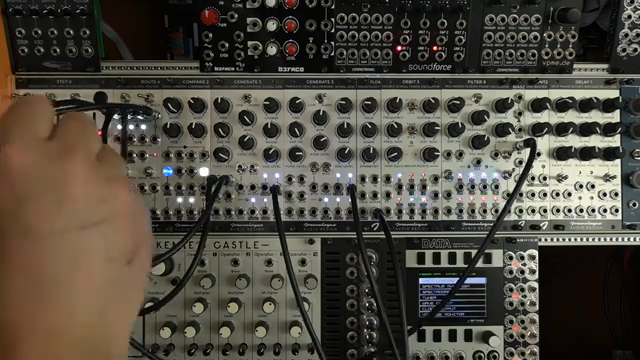
One Sequencer, Two Melodies: The Joranalogue Approach
The video opens with Simon from Joranalogue Audio Design setting the stage for a patch that’s all about efficiency and versatility. The core idea is to use the STEP 8 sequencer to generate a primary melodic sequence, and then, through some crafty patching, extract a secondary sequence that’s related but not identical. This isn’t just about saving rack space—it’s about exploring the hidden depths of modular routing.
After a brief musical demonstration, Simon outlines his plan: STEP 8 will handle the main sequence, while ROUTE 4 is drafted in to carve out a second, complementary line. The initial listen showcases the patch’s range, with parameters tweaked to highlight how much can be achieved from a relatively simple setup. It’s a classic Joranalogue move—maximising utility through thoughtful signal flow, rather than brute-forcing with more modules.
Extracting a Secondary Sequence: Patch Breakdown
Simon dives into the patch breakdown, starting with the left-panned voice sequenced by STEP 8. The right-panned voice, a Generate 3 oscillator, initially sits silent—waiting for its pitch data to arrive via the secondary sequence. The trick lies in routing: the divide-by-2 output from Bias 2 is patched into STEP 8’s signal input, providing finer pitch control. The sequence itself is shortened to seven steps by patching the eighth stage’s gate output to the reset input, a neat modular hack for non-standard sequence lengths.
To generate the secondary sequence, Simon sends selected analog outputs from STEP 8 into ROUTE 4’s routing inputs. He notes that the exact mapping isn’t critical—what matters is the concept. The first voltage (zero volts) is sent to the first stage of ROUTE 4, setting up the foundation for the secondary line. This approach allows for the extraction of a new melodic pattern, derived from but distinct to the original, simply by creative patching and signal selection.
The process is less about rigid replication and more about exploring the possibilities. Simon encourages experimentation, emphasising that the beauty of this method is its flexibility: you can rewire the patch to taste, finding new melodic relationships without needing extra sequencers.

"And then trying to extract the secondary sequence from that one sequence with Route 4 to sequence another voice."
© Screenshot/Quote: Joranalogue (YouTube)
Gate Games and ROUTE 4 Modes: Modulation in Action
"Now the easy thing to do is just connect gate outputs of step 8 to the control inputs of route 4."
© Screenshot/Quote: Joranalogue (YouTube)
With the basic routing in place, Simon demonstrates how gate outputs from STEP 8 can be patched to ROUTE 4’s control inputs, dictating which voltages are passed through at any given moment. By matching gate outputs to their corresponding voltage outputs, the secondary sequence closely mirrors the original, but with certain notes omitted—a subtle but effective way to create variation.
Simon then explores ROUTE 4’s operating modes, toggling between exclusive and multi-channel behaviour. In exclusive mode, only one input is routed at a time, while multi mode allows several signals to pass simultaneously. This opens up a world of rhythmic and melodic permutations, all controlled by the interplay of gates and voltages. The demonstration makes clear how ROUTE 4’s flexibility can be harnessed for dynamic, evolving sequences.
Creative Routing: Randomness, Logic, and Dynamic Sequences
The patch’s creative potential is pushed further by introducing randomness and logic. Simon patches a chaotic output from Orbit 3 into ROUTE 4’s control input, injecting unpredictable variation. However, he notes that pure chaos isn’t always musically satisfying, so he tempers it using Compare 2’s logic section—specifically the AND and flip-flop outputs—to quantise the randomness and bring it back into a more musical domain.
This section highlights the modular ethos: combining sources, logic, and routing to sculpt sequences that are both related and ever-changing. By blending deterministic gates with chaotic or logical modulation, Simon demonstrates how to keep a patch lively and engaging, without losing the thread of musicality.
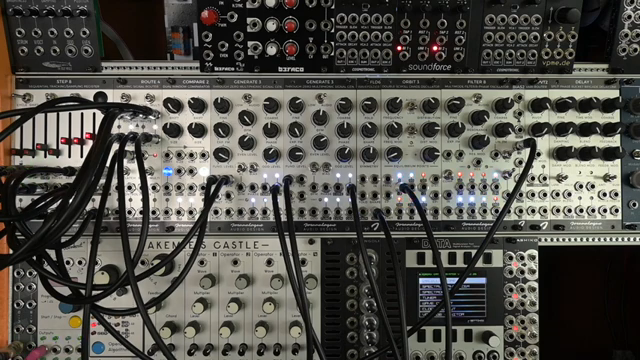
"Now, while this is random, well, it's not random, it's chaotic, I don't think it's particularly musical."
© Screenshot/Quote: Joranalogue (YouTube)
Mixdown: Stereo Tricks and Final Touches
To round things off, Simon mixes the two voices using Volt 6 as a saturating and refolding mixer, adding vibrato to the second voice via Filter 8’s self-oscillation into Generate 3’s linear FM input. Delay 1 is brought in for stereo width, with subtle modulation from Orbit 3 to keep things moving. The result is a pair of intertwined sequences, each distinct yet clearly related, panned left and right for a spacious, engaging soundscape. It’s a fitting demonstration of how a few well-chosen modules, patched with intent, can yield a rich and dynamic sonic result.
This article is also available in German. Read it here: https://synthmagazin.at/joranalogue-audio-design-sequenzierungs-alchemie-mit-step-8-und-route-4/
Watch on YouTube:
Latest articles
Watch on YouTube:
Visit the channel:
https://www.youtube.com/joranalogue
https://www.youtube.com/joranalogue
Links from joranalogue:
website: https://joranalogue.com
facebook: https://facebook.com/joranalogue
twitter: https://twitter.com/joranalogue
soundcloud: https://soundcloud.com/joranalogue
modulargrid: https://www.modulargrid.net/e/vendors/view/578
instagram: https://instagram.com/joranalogue
Sponsored links:
If you purchase via these links, we may earn a small commission – at no extra cost to you. The link opens an Amazon keyword search, and results may vary depending on availability.
Bias 2
🔗 Check price on Amazon
🔗 Check price on Amazon
COMPARE 2
🔗 Check price on Amazon
🔗 Check price on Amazon
Delay 1
🔗 Check price on Amazon
🔗 Check price on Amazon
Filter 8
🔗 Check price on Amazon
🔗 Check price on Amazon
Generate 3
🔗 Check price on Amazon
🔗 Check price on Amazon
Orbit 3
🔗 Check price on Amazon
🔗 Check price on Amazon
ROUTE 4
🔗 Check price on Amazon
🔗 Check price on Amazon
STEP 8
🔗 Check price on Amazon
🔗 Check price on Amazon
Volt 6
🔗 Check price on Amazon
🔗 Check price on Amazon