Ever fancied a Eurorack sequence that’s mostly predictable, but with a dash of chaos in just the right spot? Joranalogue Audio Design, the Belgian masters of precision analogue, deliver a tutorial that walks through exactly that—using STEP 8, SELECT 2, and a bit of clever patching to randomise only specific steps in your sequence. The video, hosted by Simon, is a patcher’s delight, showing how to wrangle randomness without losing harmonic control. If you’re after new ways to spice up your modular grooves without descending into total anarchy, this one’s for you.
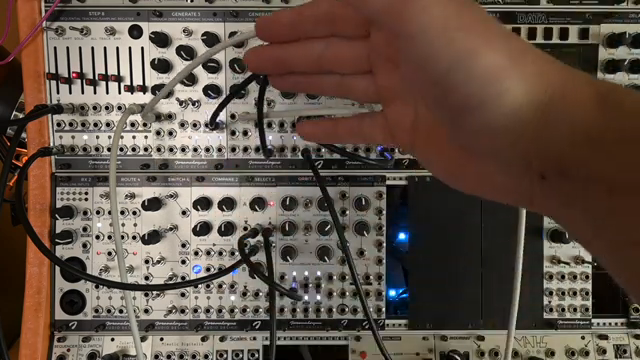
Sequencing with a Twist: The STEP 8 and SELECT 2 Combo
The tutorial opens with Simon laying out the goal: crafting a sequence on Joranalogue’s STEP 8 where only one or a handful of steps are randomised, leaving the rest to march along as programmed. This isn’t your typical random sequence—here, the unpredictability is surgically applied, not slathered across the whole pattern. The approach is all about control, letting you decide exactly which steps get the wild treatment and which remain steady.
To make this happen, the patch leans on STEP 8’s cycle mode, with the scan output feeding a volt-per-octave sequence to a pair of Generate 3 oscillators. The rest of the system is patched for a classic Joranalogue signal chain: Filter 8, Fold 6, and a bit of modulation from the second Generate 3. It’s a setup that’s as much about showcasing the modules’ clean, precise behaviour as it is about the sequencing trick itself.
Compare 2 and SELECT 2: The Randomisation Engine Room
The heart of the technique is in how randomness is injected into the sequence. By patching an output from Orbit 3—a chaos generator—into STEP 8’s input, every step becomes random, but that’s not the aim here. The clever bit is using SELECT 2 to switch between a steady 5V reference and the unpredictable output from Orbit 3, effectively toggling randomness only when desired.
Compare 2 comes into play when you want to randomise more than just the first step. By using gate outputs from STEP 8 and feeding them through Compare 2, you can define exactly which stages of the sequence will be randomised. The flip-flop output of Compare 2 acts as a gatekeeper, ensuring that only the chosen steps receive the chaos signal, while the rest stick to their programmed values.
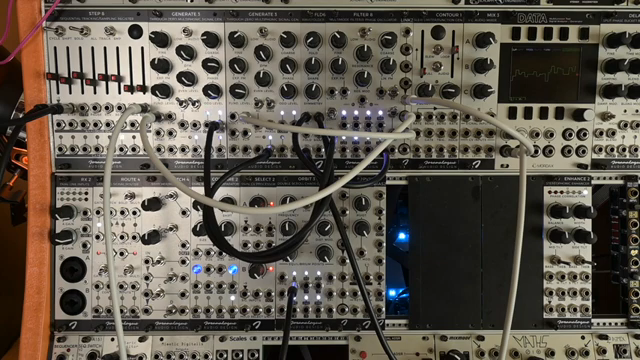
"Now every step of STEP 8 or every stage is random."
© Screenshot/Quote: Joranalogue (YouTube)
Automating Chaos: Patching for Rhythmic and Melodic Variation
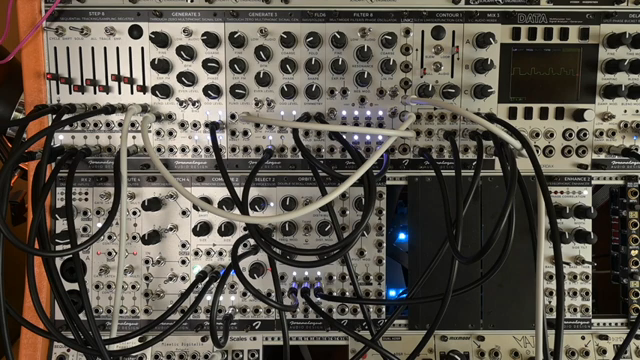
"Now we have a Uranolok pseudo-randomized waltz."
© Screenshot/Quote: Joranalogue (YouTube)
With the switching logic in place, Simon demonstrates how to automate the process so you’re not left manually flicking switches mid-performance. By connecting the gate output of a specific STEP 8 stage to the select input of SELECT 2, the system automatically routes either the random or steady voltage at the right moment. This means only the first stage—or any combination you choose—gets randomised, while the others remain fixed.
To push the patch further, Simon adds percussion using Delay 1 as a kick drum, Mix 3 for hi-hats, and Contour 1 for rimshots or snares, all sequenced and modulated by the same logic. Orbit 3’s outputs are sprinkled throughout for extra modulation and grit. The result is a rhythm section with both structure and surprise, as the randomised steps inject subtle variations into the groove.
For melodic interest, the sequence is routed through a quantizer, ensuring that even the randomised steps stay musically coherent. The patch is flexible—shortening the sequence or rearranging the randomisation logic can yield everything from pseudo-random waltzes to more traditional grooves, all with that signature Joranalogue precision.
Controlled Complexity: Harmonic Play with Random Steps
This method isn’t just a party trick; it’s a way to build complex, evolving soundscapes without surrendering harmonic control. By selectively randomising steps, you can introduce just enough variation to keep things interesting, while the rest of the sequence anchors the patch harmonically. It’s a balance between order and chaos that’s particularly appealing for live performance or generative patches.
Simon wraps up by highlighting the flexibility of the approach. Whether you want a single random step or several, the combination of STEP 8, SELECT 2, and Compare 2 gives you granular control over your sequence’s behaviour. The result is a patch that’s both playful and precise—a fitting showcase for Joranalogue’s design philosophy.
This article is also available in German. Read it here: https://synthmagazin.at/joranalogue-audio-design-zufaellige-steps-auf-laborniveau-mit-step-8-select-2/
Watch on YouTube:
Latest articles
Watch on YouTube:
Visit the channel:
https://www.youtube.com/joranalogue
https://www.youtube.com/joranalogue
Links from joranalogue:
website: https://joranalogue.com
facebook: https://facebook.com/joranalogue
twitter: https://twitter.com/joranalogue
soundcloud: https://soundcloud.com/joranalogue
modulargrid: https://www.modulargrid.net/e/vendors/view/578
instagram: https://instagram.com/joranalogue
Sponsored links:
If you purchase via these links, we may earn a small commission – at no extra cost to you. The link opens an Amazon keyword search, and results may vary depending on availability.
COMPARE 2
🔗 Check price on Amazon
🔗 Check price on Amazon
Contour 1
🔗 Check price on Amazon
🔗 Check price on Amazon
Delay 1
🔗 Check price on Amazon
🔗 Check price on Amazon
Filter 8
🔗 Check price on Amazon
🔗 Check price on Amazon
Fold 6
🔗 Check price on Amazon
🔗 Check price on Amazon
Generate 3
🔗 Check price on Amazon
🔗 Check price on Amazon
Mix 3
🔗 Check price on Amazon
🔗 Check price on Amazon
Orbit 3
🔗 Check price on Amazon
🔗 Check price on Amazon
SELECT 2
🔗 Check price on Amazon
🔗 Check price on Amazon
STEP 8
🔗 Check price on Amazon
🔗 Check price on Amazon