As Black Friday’s siren song tempts us with new synths and plugins, Jameson Nathan Jones drifts through the fog of consumer desire to reveal a deeper compositional truth. In his signature poetic style, Jones invites us to strip away the magnetic allure of gear and rediscover the emotional resonance of intentional notecraft. This video is not just a critique—it’s a gentle call to reclaim the narrative of our music, to let sequences bloom and harmonies breathe. For those lost in the endless nebula of sound design, Jones offers a map back to the heart of creation.
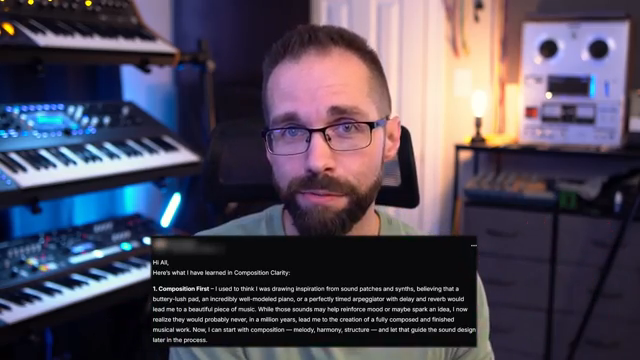
The Mirage of More: Gear and the Creative Void
As November’s chill settles, the marketplace hums with promises: inspiration is just a purchase away, they say. Jameson Nathan Jones opens his video by gently unraveling this myth, confessing that even he has been lured by the magnetic resonance of new machines. The allure is understandable—these devices shimmer with potential, each one a vessel for sonic ghosts and future dreams. Yet, Jones suggests, the cycle of acquisition can become a fog, obscuring the path to genuine creativity.
He reflects on the paradox: while gear can spark ideas, it can just as easily become a labyrinth, trapping us in endless exploration with little to show. The temptation to seek the “perfect sound” is strong, but it often leads to unfinished sketches and abandoned tracks. The real breakthrough, he hints, lies not in the next plugin or synth, but in stripping away the excess and returning to the elemental act of arranging notes.
This opening critique is not a rejection of technology, but a call to recalibrate our relationship with it. Jones’s tone is gentle, almost cinematic, inviting us to pause and consider what truly moves us. The machines are not the enemy—they are tools, waiting for a story to inhabit them. The question is: whose story will it be?
"A lot of companies are going to try to convince you that you need to buy your way into inspiration by buying more gear."
© Screenshot/Quote: Jamesonnathanjones (YouTube)
Notes Before Nebula: The Power of Sequence
"When I start with the notes, suddenly things like development and arrangement become much, much easier."
© Screenshot/Quote: Jamesonnathanjones (YouTube)
Jones’s philosophy unfolds like a slow dawn: start with the notes, not the timbres. He shares insights from his composition cohorts, where many participants arrive conditioned to begin with sound design, sculpting textures before melodies. This approach, he observes, often leads to sequences that loop endlessly, their harmonic landscapes stagnant and unchanging. The revelation, he says, comes when one dares to invert the process—when the sequence of notes becomes the seed from which all else grows.
He recalls his own journey, rooted in classical training, where music began with pencil, paper, and the tactile intimacy of the piano. The transition to synthesizers brought a seductive freedom, but also a kind of amnesia—a forgetting of harmonic craft in favor of surface shimmer. Jones describes how easy it is to fall into the gravitational pull of familiar patterns, echoing the same three-note basslines and static loops that haunt so much electronic music. The machines, in their infinite possibility, can become both muse and jailer.
Yet, he insists, there is a way out. By foregrounding note choices—by letting harmony and thematic development guide the hand—arrangement and emotional depth emerge almost effortlessly. The act of composing becomes less about chasing the next happy accident and more about shaping a narrative, one that can bloom and evolve. This is not a denial of sound’s importance, but a re-centering: sound design becomes a color, a variable, rather than the canvas itself.
In this section, Jones’s argument is both practical and poetic. He acknowledges the thrill of exploration, the necessity of learning what the machines can do. But he urges us to move beyond the surface, to seek the kind of music that breathes and delivers emotionally. The path to finishing songs, he suggests, is paved with intentionality—each note a stepping stone out of the fog. For those willing to listen, this is an invitation to reclaim authorship, to let the sequence lead and the synth follow. The result is music that feels less like a looped mirage and more like a living, breathing journey.
Composing as Directing: The Filmmaker’s Blueprint
Midway through the video, Jones conjures a vivid analogy: composing music is akin to directing a film. He recounts a conversation from his cohort, where someone likened intentional musical planning to a director’s script. In cinema, actors don’t simply improvise entire scenes—there is a vision, a blueprint, a narrative arc. The same, he argues, should be true for music.
Yet, the analogy deepens. Just as actors can surprise a director and breathe unexpected life into a role, technology—our synths and plugins—can offer serendipitous moments. But the plan remains the creator’s own. Jones draws on the story of Aaron Paul’s character in Breaking Bad, illustrating how collaboration and surprise can enhance, but not replace, intentional authorship. The machines, like actors, bring their own strengths and quirks, but they do not write the script.
This section is a meditation on balance: between control and discovery, intention and accident. Jones’s narrative reminds us that while gear can transform material in beautiful ways, it is the composer’s vision that shapes the arc. In a world awash with filter sweeps and algorithmic loops, the blueprint—the sequence—becomes the guiding star, ensuring the music’s emotional resonance endures.
"No one would just call in actors to improvise a scene. Well, I mean, that's a very different kind of film."
© Screenshot/Quote: Jamesonnathanjones (YouTube)
Constraints as Constellations: The Creative Prompt
"The most consistent way to do that that I found is to start with the notes."
© Screenshot/Quote: Jamesonnathanjones (YouTube)
As the session draws to a close, Jones offers a practical prompt—a constellation of constraints designed to ignite creativity. He challenges viewers to compose with only two independent parts, each moving together in parallel or contrary motion, limited to eight moves in total. The rules are precise: avoid doubling notes, restrict repetition, and never end where you began. In this narrow corridor, he suggests, lies a universe of possibility.
He urges us to focus on phrase shapes, to consider the emotional arc of even the simplest lines. Should the melody ascend, descend, or arc in opposition? Each choice becomes a brushstroke, painting intention across the silence. The exercise is not about theory or complexity, but about listening deeply—to the movement, the interplay, the spaces between. Within these self-imposed boundaries, every note becomes luminous, every interval charged with meaning.
Jones’s prompt is more than a technical exercise; it is an invitation to rediscover wonder in limitation. He reminds us that the most resonant music is often born from constraint, not abundance. By zooming in on the microcosm of two voices, we learn to craft independence, tension, and release. The result is music that moves—music that tells a story, even in miniature.
In closing, Jones extends an open hand: for those who find these ideas new or challenging, his cohorts offer a space to explore and grow. The video ends not with a sales pitch, but with a sense of possibility—a reminder that, in the right hands, even the simplest sequence can become a nebula of emotion, a magnetic field of inspiration waiting to be shaped.
This article is also available in German. Read it here: https://synthmagazin.at/jameson-nathan-jones-komponieren-jenseits-der-gear-fata-morgana/
Watch on YouTube:
Latest articles
Watch on YouTube:
Visit the channel:
https://www.youtube.com/JamesonNathanJones
https://www.youtube.com/JamesonNathanJones
Links from JamesonNathanJones:
Website: https://jamesonnathanjones.com
Music Channel: https://youtube.com/@JamesonNathanJonesMusic
Bandcamp: https://jamesonnathanjones.bandcamp.com
Instagram: https://instagram.com/jamesonnathanjones