Intellijel’s SVF 1U brings classic state variable filtering to the slim 1U Eurorack format, promising versatility without the usual space penalty. In this official walkthrough, Intellijel demonstrates how the SVF 1U’s multimode outputs, input clipping, and modulation options can shape everything from smooth sweeps to percussive pings. As always, Intellijel’s presentation is clear and patch-focused, showing not just what the module can do, but how it wants to be patched. For those looking to squeeze more sound-sculpting power into a tight rack, this filter’s blend of classic topology and modern utility is worth a closer look.
13. August 2024
MILES
Intellijel’s SVF 1U: Compact State Variable Filtering for the Modern Eurorack
A State Variable Filter for the 1U Realm
The SVF 1U is Intellijel’s answer to the challenge of bringing full-featured filtering to the often-overlooked 1U Eurorack format. Right from the outset, the video makes clear that this is a state variable filter, meaning it offers multiple simultaneous filter modes—low pass, band pass, high pass, and notch—each available at dedicated outputs. The design is described as simple and sweet sounding, with a focus on musicality rather than over-complication.
Despite its compact footprint, the SVF 1U is positioned as a versatile tool for a wide range of sound design tasks. The video walks through the basic filter modes, demonstrating how each can be used to sculpt and animate different sonic textures. This isn’t just a utility filter for squeezing into a cramped rack; it’s presented as a creative centrepiece capable of both subtle tone shaping and more dramatic effects.

"This is the SVF1U, a multi-mode state variable filter designed for the 1u euro rack format."
© Screenshot/Quote: Intellijel (YouTube)
Multimode Outputs, Input Clipping, and CV Modulation
"The SVF has two options for clipping the input stage, selectable with this switch."
© Screenshot/Quote: Intellijel (YouTube)
One of the SVF 1U’s defining features is its trio of output modes, allowing users to tap into classic filter responses simultaneously. The video showcases these outputs in action, with musical examples highlighting the character of each mode. This flexibility is further enhanced by the input stage, which offers three selectable clipping options via a switch: clean, soft clipping, and soft clipping with a 6dB boost. These choices let users tailor the filter’s response to different signal levels and desired saturation.
Modulation is another area where the SVF 1U stands out. The module includes two CV inputs for cutoff frequency: an FM input with an attenuverter for precise control, and a pitch input that tracks volt per octave. This dual approach enables both nuanced modulation and melodic tracking, making the filter equally at home in experimental patches and more traditional synth lines.
Complex Modulation for Deep Sound Shaping
The SVF 1U’s modulation inputs open the door to intricate sound shaping, as demonstrated in the video. The FM input, equipped with an attenuverter, allows for detailed control over the cutoff frequency, responding well to both slow LFO sweeps and snappier envelope signals. Meanwhile, the pitch input tracks 1V/oct, enabling the filter to follow melodic lines or sequence in tune with oscillators.
By combining multiple CV sources, users can create evolving, morphing filter movements that go far beyond static sweeps. The video illustrates this by modulating the cutoff with several CV signals at once, resulting in complex, shifting timbres. This flexibility makes the SVF 1U a powerful tool for those who like to push their patches into more animated and unpredictable territory.
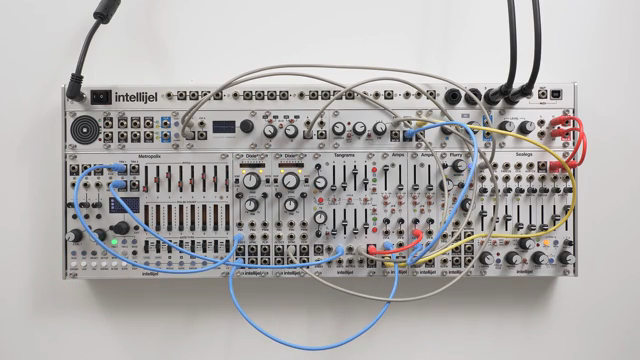
"There's the pitch input, which tracks volt per octave. This is great to use in patches where you want the filter to follow the pitch of your sound source."
© Screenshot/Quote: Intellijel (YouTube)
Self-Oscillation and Feedback: Sine to Saw
"When we increase the filter Q, SVF1U self-oscillates. Normally it outputs a sine wave, but we can change this by using feedback patching."
© Screenshot/Quote: Intellijel (YouTube)
A highlight of the SVF 1U is its ability to self-oscillate when the resonance (Q) is cranked. In this mode, the filter turns into a clean sine wave oscillator, which can be tracked accurately via the pitch CV input. This opens up classic filter-as-oscillator tricks, useful for everything from FM percussion to melodic lines.
The video goes further, showing how feedback patching can morph the self-oscillating sine into other waveforms. By routing the band pass output back into the FM input and increasing the attenuverter, the sine wave transforms into a sawtooth. This kind of feedback-based waveshaping is a classic modular move, and it’s refreshing to see it demonstrated so clearly in a 1U context. Sequencing the resulting waveform via the pitch input adds even more sonic potential.
Output Mixing and Notch Customisation
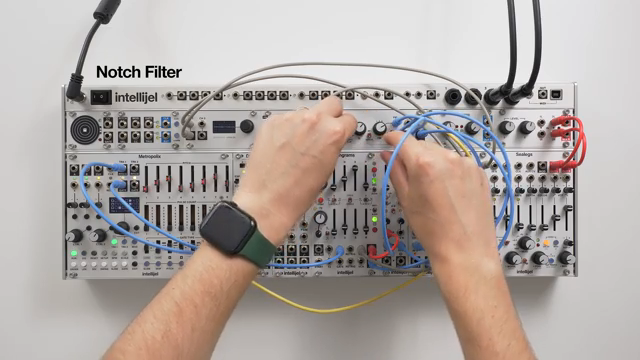
Beyond its core filtering duties, the SVF 1U offers additional features for creative sound design. The video demonstrates how mixing different outputs—such as combining the two-pole low pass and band pass—can yield new filter responses, like a one-pole low pass. This output mixing encourages experimentation and lets users tailor the filter’s behaviour to their patching needs.
Another thoughtful touch is the adjustable notch output, which can be rebalanced via a trimmer on the back of the module. By default, the notch is set to a 75% high pass and 25% low pass mix, but this can be tweaked for different balances of symmetry, resonance, and output level. The video provides audio examples of how these adjustments affect the sound, underscoring the SVF 1U’s flexibility for those who like to fine-tune every aspect of their signal path.
This article is also available in German. Read it here: https://synthmagazin.at/intellijel-svf-1u-kompakter-state-variable-filter-fuer-moderne-eurorack-racks/
Watch on YouTube:
Latest articles
Watch on YouTube:
Visit the channel:
https://www.youtube.com/intellijel
https://www.youtube.com/intellijel
Links from intellijel:
website: https://intellijel.com
forum: https://forum.intellijel.com
instagram: https://instagram.com/intellijel
facebook: https://www.facebook.com/intellijel
Sponsored links:
If you purchase via these links, we may earn a small commission – at no extra cost to you. The link opens an Amazon keyword search, and results may vary depending on availability.
Intellijel SVF 1U
🔗 Check price on Amazon
🔗 Check price on Amazon