Intellijel, the Canadian modular stalwart, dives deep into the hidden corners of their Cascadia semi-modular with a feature that’s as quirky as it is powerful: the Entropic Sequence Generator (ESG). In this official walkthrough, Matt from Intellijel demonstrates how ESG transforms Envelope B into a source of evolving random voltages, perfect for those who crave unpredictability in their patches. The video covers enabling ESG, its core controls, and creative modulation tricks, all delivered in Intellijel’s signature practical style. For anyone with a taste for generative chaos or just looking to spice up their voltage streams, this is a must-watch.

1. June 2024
MILES
Intellijel’s Cascadia: Unveiling the Entropic Sequence Generator
Meet the Entropic Sequence Generator
Intellijel’s Cascadia hides a rather intriguing function beneath its surface: the Entropic Sequence Generator, or ESG. This feature, tucked away in Envelope B, is designed to generate repeatable random voltage sequences ranging from a single step up to a sprawling 16 steps. The ESG isn’t just about randomness for its own sake—it offers a means to create evolving patterns that can loop indefinitely, morph over time, or dissolve into pure unpredictability depending on how you set it up.
As Matt explains, the ESG is perfect for those moments when you want to inject a bit of controlled chaos into your patches. Rather than relying on static modulation or predictable LFO shapes, the ESG brings a layer of generative voltage that can inspire new ideas or add subtle movement to your sound design. It’s a classic example of Intellijel’s approach: practical, musical, and always with an eye towards deeper patching possibilities.

"The ESG generates repeatable random voltage sequences from 1 to 16 steps in length, with variable probability of per-step regeneration."
© Screenshot/Quote: Intellijel (YouTube)
Two Paths to Randomness: Enabling ESG
"The first method can be done without a computer."
© Screenshot/Quote: Intellijel (YouTube)
Activating the ESG on Cascadia is refreshingly straightforward, with two distinct methods on offer. The first is a hardware-only approach: by powering down the unit, holding the button next to MIDI LFO in the MIDI to CV section, and powering back on while holding the button, you’ll see the LED flash rapidly—confirmation that ESG mode is now active. This method is ideal for those who prefer to keep computers out of their patching workflow, maintaining that tactile, hands-on ethos.
For users who don’t mind a bit of USB action, the Intellijel Config app provides an alternative. After connecting Cascadia to your computer, simply open the app, navigate to the Envelope B section, and select Entropic Sequence Generator from the LFO Shape dropdown. Both methods achieve the same result, letting you decide whether you want to keep things strictly hardware or embrace a bit of software convenience. Either way, once enabled, ESG takes over Envelope B’s LFO function, ready to start spitting out random voltages.
Rise, Fall, Shape: ESG’s Core Controls
The ESG is governed by three main controls: Rise, Fall, and Shape. The Rise parameter sets the rate of the sequence in free mode, directly affecting how quickly the steps cycle. In sync mode, Rise acts as a clock divider or multiplier, responding to external clock signals patched into the gate sync input. The push gate can also serve as a tap tempo, giving further flexibility in how the sequence progresses.
Fall, on the other hand, determines the length of the sequence, anywhere from a single step to a full 16-step cycle. This allows for anything from stuttering, minimal patterns to more elaborate evolving sequences. The Shape control is where the real magic happens: it sets the probability that each step will regenerate its voltage value on every cycle. At 0%, the sequence is locked and repeats identically; as you increase Shape, steps begin to change, and at 100%, the sequence becomes fully random. This trio of controls makes ESG a versatile tool for both subtle modulation and wild generative experiments.
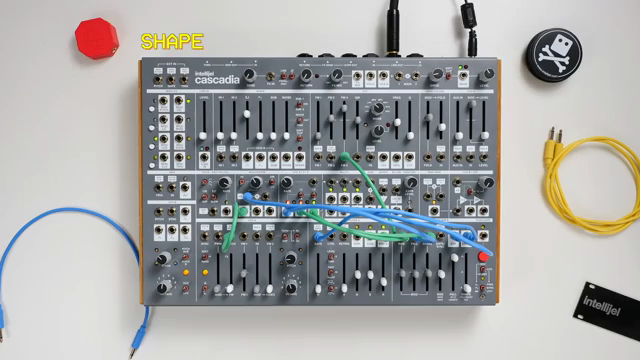
"Shape controls the per step regeneration probability and can be set between 0 and 100%."
© Screenshot/Quote: Intellijel (YouTube)
Creative Modulation and Patch Potential
Intellijel’s demo doesn’t stop at the basics—Matt shows how ESG’s parameters can be modulated for even more complex behaviour. By patching LFO outputs into the Rise, Fall, and Shape modulation inputs, you can dynamically alter the sequence’s rate, length, and randomness in real time. This opens up a world of evolving, self-generating patterns that can be as restrained or as chaotic as you like.
The ESG output isn’t limited to pitch sequences either. It can be routed to modulate filters, timbral controls, or any CV destination on Cascadia, making it a flexible source of unpredictable movement. Whether you’re after subtle variations or full-blown generative madness, ESG’s integration with Cascadia’s patchbay ensures it can play a central role in your modular explorations.
Embrace the Random: Editorial Encouragement

"Get random. Get weird. Try out the Entropic Sequence Generator on Cascadia and see what you come up with."
© Screenshot/Quote: Intellijel (YouTube)
Matt wraps up by urging users to experiment with the ESG, highlighting its ability to cycle indefinitely and morph between order and disorder. The feature is clearly aimed at those who enjoy pushing their modular systems into new territory, using randomness as a creative tool rather than just a novelty.
For anyone with a Cascadia, the ESG is a hidden gem worth unlocking—one that rewards curiosity and a willingness to get a bit weird with your voltage streams.
This article is also available in German. Read it here: https://synthmagazin.at/intellijel-cascadia-die-entdeckung-des-entropic-sequence-generator/
Watch on YouTube:
Latest articles
Watch on YouTube:
Visit the channel:
https://www.youtube.com/intellijel
https://www.youtube.com/intellijel
Links from intellijel:
website: https://intellijel.com
forum: https://forum.intellijel.com
instagram: https://instagram.com/intellijel
facebook: https://www.facebook.com/intellijel
Sponsored links:
If you purchase via these links, we may earn a small commission – at no extra cost to you. The link opens an Amazon keyword search, and results may vary depending on availability.
Intellijel Cascadia
🔗 Check price on Amazon
🔗 Check price on Amazon