Intellijel returns with Jellymix, a compact stereo performance mixer aimed squarely at modular enthusiasts and DAWless tinkerers. In this official walkthrough, Matt from Intellijel demonstrates how Jellymix brings drum machines, synths, and effects together with a streamlined interface and clever routing options. Expect a practical tour of features, a hands-on patching session, and a jam that showcases just how much mixing power can be packed into a small footprint. For those who crave flexible signal flow and real-time control in their Eurorack or desktop setup, this video is a revealing look at what Jellymix can do.

21. February 2026
MILES
Intellijel Jellymix: Compact Mixing Muscle for Modular Mayhem
Elektron Digitakt MkI, Intellijel Cascadia, Intellijel Jellymix, Strymon Volante
Jellymix: Small Box, Big Ambitions
Jellymix is Intellijel’s latest foray into the world of compact stereo performance mixers, and it’s clearly designed with the modular crowd in mind. The video kicks off with Matt introducing Jellymix as the glue for integrating drum machines, synthesizers, effects, and modular signals into a unified setup. This isn’t just another desktop mixer—it’s tailored for those who want to patch, tweak, and perform without leaving the modular ecosystem.
The emphasis here is on versatility and size. Jellymix promises to bring together disparate gear—be it a Digitakt, a Cascadia, or a pedal like the Strymon Volante—without hogging precious rack or desk space. The video sets the stage for a practical exploration, hinting at both straightforward mixing duties and more creative routing possibilities.
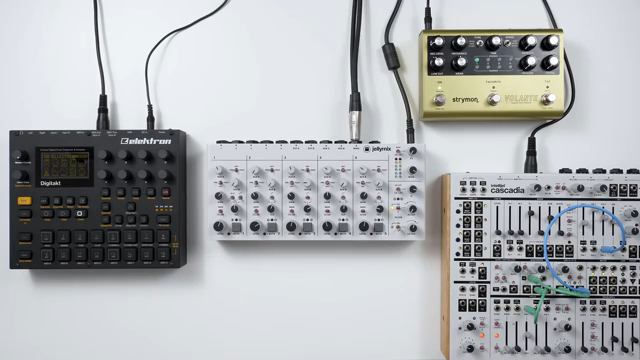
"Jelly Mix is our brand new compact stereo performance mixer designed to bring together all of your drum machines, your synthesizers, effects, and modular as well."
© Screenshot/Quote: Intellijel (YouTube)
Five Channels, Two Auxes, and Sculpting Tools
"Each one of these Auxes has a routing switch, so it can either be pre-fader, post-fader or off altogether."
© Screenshot/Quote: Intellijel (YouTube)
The heart of Jellymix lies in its five input channels, each equipped to handle stereo signals and ready for a variety of sources. Matt walks us through the back panel, where five pairs of quarter-inch jacks await your synths and drum machines, alongside two external input pairs for even more flexibility. Outputs are clearly marked, including dedicated Aux A and Aux B sends, a main stereo out, and a headphone jack for monitoring.
Each channel is more than just a volume fader. You get a gain control for proper level staging, a high pass filter to tame low-end rumble, and a tilt EQ for quick tonal shaping—ideal for balancing out a busy mix on the fly. The two Aux sends per channel, each with pre/post/off routing switches, open up a world of effects possibilities, whether you want to send a dry synth to delay or create feedback loops. It’s a thoughtful set of features for those who see their mixer as an instrument, not just a utility.
Plug, Play, and Patch: A Basic Setup in Action
Matt moves from theory to practice by wiring up a simple but effective rig: Digitakt on one channel, Cascadia on another, and a Strymon Volante pedal returning on a third. The setup process doubles as a front panel tour, with each control explained as it’s zeroed out—gain, level, EQ, filter, and routing switches all get a mention.
Once everything’s patched, Matt demonstrates how to bring in signals, monitor levels using the VU meter, and keep headroom in check. The workflow is intuitive: turn up the levels, watch the LEDs, and adjust to taste. The tilt EQ is tested for quick tonal shifts, and the high pass filter is engaged to clean up the low end. It’s a clear, hands-on demonstration of how Jellymix can slot into a modular or DAWless setup with minimal fuss.
Performance Tricks: Mutes, Routing, and Filter Play
Jellymix isn’t just about static mixing—it’s built for real-time manipulation. Matt highlights the clickless mute buttons, which are both smooth and responsive, allowing performers to prep and release multiple channels in unison. This is a subtle but powerful feature for live sets, where timing is everything.
Routing options are equally flexible. Each channel’s Aux sends can be set pre- or post-fader, making it easy to send signals to effects or create feedback loops. Matt demonstrates sending Cascadia to the delay via Aux A, tweaking the tilt EQ to shape the effect return, and even using the mixer itself to generate feedback—a classic modular trick.
The filter section is another creative tool. With both high and low cut filters, resonance (Q) control, and bypass switches, you can sculpt the mix or sweep frequencies mid-performance. The ability to route channels through the filter and then instantly bypass it gives performers dynamic control over their sound, perfect for drops, builds, or sudden tonal shifts.
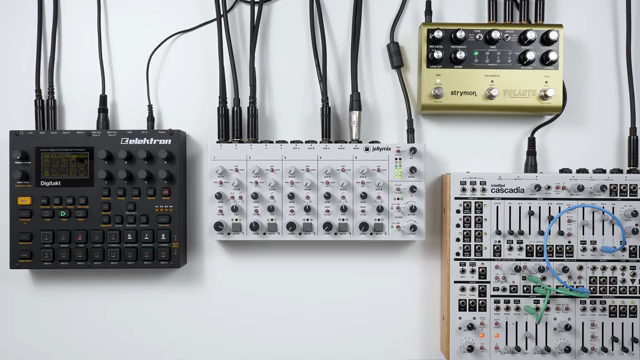
"These are clickless mutes, so they're very smooth, but they're also very responsive."
© Screenshot/Quote: Intellijel (YouTube)
Jam Time: Jellymix in the Wild
The video wraps up with a jam session, letting Jellymix flex its muscles in a real-world context. Matt blends drum machine, synth, and effects, using mutes, filters, and routing tricks to keep the mix lively and evolving. It’s a practical demonstration of how the mixer’s features translate to hands-on performance.
While the jam is brief, it showcases the immediacy and flexibility that Jellymix offers. For modular users and DAWless performers alike, the takeaway is clear: this compact mixer isn’t just a signal hub—it’s a creative tool that rewards those who like to get their hands dirty with patch cables and live tweaks.
This article is also available in German. Read it here: https://synthmagazin.at/intellijel-jellymix-kompaktes-mix-monster-fuer-modulare-klangabenteuer/
Watch on YouTube:
Latest articles
Watch on YouTube:
Visit the channel:
https://www.youtube.com/intellijel
https://www.youtube.com/intellijel
Links from intellijel:
website: https://intellijel.com
forum: https://forum.intellijel.com
instagram: https://instagram.com/intellijel
facebook: https://www.facebook.com/intellijel
Sponsored links:
If you purchase via these links, we may earn a small commission – at no extra cost to you. The link opens an Amazon keyword search, and results may vary depending on availability.
Elektron Digitakt MkI
🔗 Check price on Amazon
🔗 Check price on Amazon
Intellijel Cascadia
🔗 Check price on Amazon
🔗 Check price on Amazon
Intellijel Jellymix
🔗 Check price on Amazon
🔗 Check price on Amazon
Strymon Volante
🔗 Check price on Amazon
🔗 Check price on Amazon