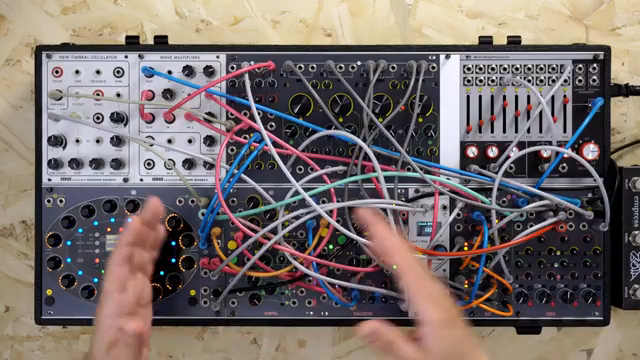
Frap Tools returns with a deep-dive into modular composition, as Francesco Gennari unpacks his latest étude, “Studio No. 2.” This video is a rare treat for anyone obsessed with stereo imaging, as Gennari demonstrates the art of crafting two-note dyads that dance across the stereo field. From piano sketches to a fully realised Eurorack patch, the walkthrough covers everything from using filters as oscillators to sequencing evolving patterns with the USTA. Expect a meticulous breakdown of patching, modulation, and the integration of external effects, all delivered with Frap Tools’ signature attention to sonic detail and workflow.
9. April 2025
MILES
Frap Tools: Dissecting Stereo Dyads and Modular Choreography in Studio No. 2
Empress Zoia, Frap Tools 321, Frap Tools 333, Frap Tools Cunsa, Frap Tools Falistri, Frap Tools QSC, Frap Tools Sapèl, Frap Tools USTA, Pamela's Pro Workout, Random Source NTO, Verbose Multi-Delay Processor
Stereo Dyads: A Modular Performance Unveiled
Francesco Gennari opens the session by presenting his composition, “Studio No. 2,” a piece that revolves around the concept of stereo dyads—two-note chords spatially distributed across the stereo field. The performance is a showcase of modular precision, with Gennari using filters as oscillators and employing dynamic panning to sculpt an immersive soundstage. The result is a piece that feels both minimal and expansive, with each dyad carefully positioned for maximum spatial effect.
After the live performance, Gennari promises a detailed breakdown of the patch and the creative decisions that shaped the track. The focus on stereo dyads is not just a compositional quirk but a deliberate exploration of how modular synthesis can manipulate space as much as tone. This approach sets the stage for a technical journey through both the musical and patching strategies behind the piece.
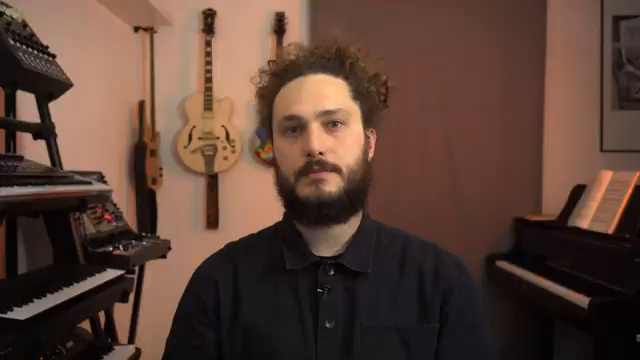
"In this piece, Studio No. 2, I explore stereophonic dyads, use filters as oscillators, and apply dynamic panning to sculpt the stereo field."
© Screenshot/Quote: Fraptools (YouTube)
From Piano Keys to Patch Cables: The Creative Process
"I structured the sound chain to define the timbre of each part according to the character I wanted for the track."
© Screenshot/Quote: Fraptools (YouTube)
Gennari reveals that his workflow begins at the piano, where he sketches out the rhythmic, melodic, and harmonic foundations of the piece. This traditional starting point grounds the composition before it migrates into the modular domain, ensuring that the electronic textures serve a clear musical purpose.
Once the structure is set, the ideas are transcribed onto the modular system, where the sound chain is meticulously crafted to define the timbre of each element. The process involves translating the smoothness of dyads and bass from the piano into evolving modular voices, with particular attention paid to how each part will interact within the stereo field and over time.
Filters as Oscillators and USTA Sequencing: The Technical Backbone
A key technical highlight is Gennari’s use of the Cunsa filters in self-oscillation, effectively turning them into precise oscillators for generating the stereo dyads. By pushing the resonance and Q to their limits, the filters produce stable pitches that can be sequenced melodically, demonstrating the flexibility of the Cunsa beyond traditional filtering duties.
The USTA sequencer plays a central role in arranging the track, with its song mode enabling custom pattern sequences and dynamic repetition. Gennari walks through the process of entering edit mode, selecting patterns, and assigning repetition counts, all of which allow for intricate, evolving structures without manual intervention. This combination of unconventional sound sources and advanced sequencing forms the backbone of the piece’s technical identity.
Complex Sound Design: Patching, Modulation, and Evolving Tones
The heart of the sound design lies in the interplay between the Cunsa filters, modulation sources, and a carefully orchestrated signal flow. Two Cunsa filters, set to self-oscillate, generate the stereo dyads, with their frequencies controlled by USTA’s CV outputs. Gennari primarily uses the low-pass outputs, blending in band-pass signals and white noise for additional texture, all dynamically attenuated and summed via the 321 and 333 modules.
To add movement, subtle vibrato is introduced using two sine LFOs from Pamela’s Pro Workout, clocked independently and routed to the filters’ frequency CVs. The summed signals are then sent to the QSC mixer, with one dyad panned left and the other right, creating a vivid stereo image. For further complexity, a distorted layer is crafted by routing the mixed outputs through a wave multiplier and additional saturation stages, with sample-and-hold modulation from Pamela providing animated panning.
The bass voice is no afterthought: Falistri’s green section acts as an oscillator, filtered through another Cunsa, with slow LFO modulation and QSC crossfading between low-pass and high-pass signals. This ensures the bass remains both solid and subtly evolving, underpinning the more ethereal dyads above.
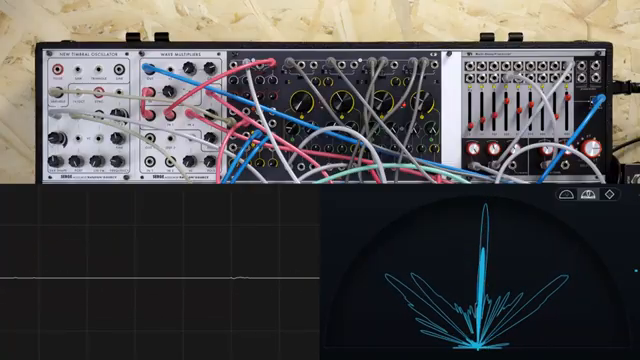
"The stereo dyads are generated using two Cunsa filters in self oscillation."
© Screenshot/Quote: Fraptools (YouTube)
External Effects: Integrating the Empress Zoia for Sonic Expansion

"On this pedal, I create a patch with three parallel effects, a ping-pong delay clocked by gate A of Ustas Track 4, a reverb and a distortion."
© Screenshot/Quote: Fraptools (YouTube)
Gennari rounds out the patch by integrating external effects, notably the Empress Zoia pedal, to further expand the sonic palette. One aux send from the QSC mixer is routed to a multi-delay processor, where manual blending of delay times and built-in reverb add depth and ambience to the modular signals.
The other aux send feeds the Empress Zoia, which is patched with three parallel effects: a ping-pong delay (clocked by USTA), reverb, and distortion. This setup allows for real-time tweaking of parameters, with Gennari demonstrating how increasing the distortion at the track’s end adds a final burst of energy. The result is a hybrid workflow where modular synthesis and pedal-based processing interact seamlessly, pushing the composition beyond the confines of the rack.
This article is also available in German. Read it here: https://synthmagazin.at/frap-tools-stereo-dyaden-und-modulare-choreografie-in-studio-no-2-entschluesselt/
Watch on YouTube:
Latest articles
Watch on YouTube:
Visit the channel:
https://www.youtube.com/FrapTools
https://www.youtube.com/FrapTools
Links from FrapTools:
website: https://frap.tools
instagram: https://instagram.com/fraptools
facebook: https://www.facebook.com/fraptools
twitter: https://twitter.com/fraptools
soundcloud: https://soundcloud.com/fraptools
Sponsored links:
If you purchase via these links, we may earn a small commission – at no extra cost to you. The link opens an Amazon keyword search, and results may vary depending on availability.
Empress Zoia
🔗 Check price on Amazon
🔗 Check price on Amazon
Frap Tools 321
🔗 Check price on Amazon
🔗 Check price on Amazon
Frap Tools 333
🔗 Check price on Amazon
🔗 Check price on Amazon
Frap Tools Cunsa
🔗 Check price on Amazon
🔗 Check price on Amazon
Frap Tools Falistri
🔗 Check price on Amazon
🔗 Check price on Amazon
Frap Tools QSC
🔗 Check price on Amazon
🔗 Check price on Amazon
Frap Tools Sapèl
🔗 Check price on Amazon
🔗 Check price on Amazon
Frap Tools USTA
🔗 Check price on Amazon
🔗 Check price on Amazon
Pamela's Pro Workout
🔗 Check price on Amazon
🔗 Check price on Amazon
Random Source NTO
🔗 Check price on Amazon
🔗 Check price on Amazon
Verbose Multi-Delay Processor
🔗 Check price on Amazon
🔗 Check price on Amazon