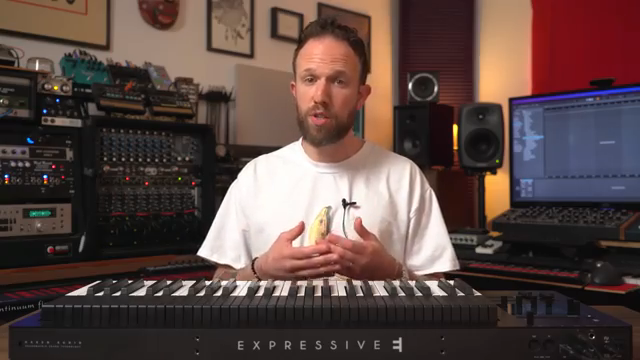
Expressive E’s Osmose isn’t just another MIDI controller—it’s a flagship MPE keyboard designed to inject unprecedented nuance and physicality into software synth workflows. In this detailed tutorial, Expressive E (with Josh Madoff at the helm) demonstrates how Osmose bridges the gap between tactile performance and digital sound design, focusing on MPE-compatible plugins and the company’s own Expressive Suite. The video moves from setup basics through hands-on mapping, then into a showcase of tailored presets and even creative hacks for non-MPE synths. For anyone interested in the architecture of expressive control, this is a deep dive into how Osmose can transform both your DAW and your playing.
3. April 2025
LYRA
Expressive E’s Osmose: Unlocking MPE Expression in Software Synths
Ableton Drift, Baby Audio BA-1, Cherry Audio DCO-106, Legend HZ by Synapse Audio, Myth by Dawson, Noisy 2, Osmose, Phase Plant, Vital
Osmose: A New Paradigm for Expressive Control
The Osmose is introduced as a revolutionary MPE keyboard, aiming to elevate the creative possibilities when controlling software instruments. Expressive E positions it as a tool that brings new levels of nuance and physical engagement to digital sound design, leveraging the power of MIDI Polyphonic Expression (MPE). The video’s host, Josh Madoff, sets the stage by highlighting how software instruments have democratized music production, but notes that Osmose’s unique interface can take expressivity even further.
From the outset, the focus is on how Osmose’s design philosophy is rooted in translating natural gestures—pressure, movement, and touch—into detailed control over sound. This isn’t just about triggering notes; it’s about shaping every aspect of a performance in real time. The promise is clear: Osmose is not another generic controller, but a performance instrument that redefines what’s possible with software synths.
MPE Workflow: External MIDI Mode and Per-Key Expression
A core feature of Osmose is its ability to switch seamlessly into external MIDI mode, unlocking its full MPE capabilities for software synths. The tutorial walks through the process: a simple click on the ‘M’ in the corner toggles the instrument from its internal sound engine to external MIDI, ready for MPE action. This workflow is refreshingly direct, minimizing menu-diving and making it easy to jump between standalone and controller roles.
Once in MPE mode, Osmose delivers per-key pitch bend, aftertouch, and pressure sensitivity—each assignable to different parameters within compatible plugins. The video demonstrates this with Vital, showing how aftertouch can be mapped to a filter cutoff for nuanced, finger-driven modulation. The mapping process is straightforward: right-click, MIDI learn, and you’re set. This hands-on approach is echoed with Cherry Audio’s DCO-106, where MPE assignments are visually accessible and can be tailored to X (pitch), Y (aftertouch), or Z (pressure) axes.
The workflow is not just about technical flexibility but about immediacy. The host emphasizes how tiny variations in finger pressure translate into expressive filter sweeps and automation, all of which are captured during recording. This per-note expressivity is at the heart of the MPE promise, and Osmose’s implementation appears both robust and intuitive in these demonstrations.
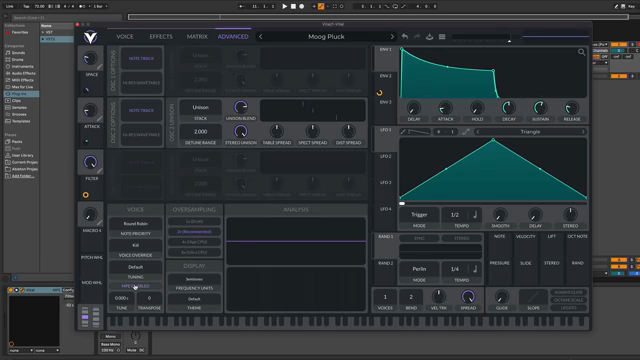
"As soon as you enable MPE mode on Vital, you should already have per key pitch bend, but at least in my experience, nothing was pre-mapped to pressure or aftertouch."
© Screenshot/Quote: Expressivee (YouTube)
Showcasing MPE-Ready Synths: Vital, DCO-106, and Drift
The video moves through a trio of software synths—Vital, Cherry Audio’s DCO-106, and Ableton’s Drift—to illustrate the breadth of MPE integration. Each synth is set up to receive Osmose’s multi-dimensional data, with the host highlighting both the ease of configuration and the sonic results. In Vital, aftertouch is mapped to the filter for dynamic arpeggiator performances, while DCO-106 benefits from pressure glide and per-key pitch bend, adding a new dimension to classic analog emulations.
Ableton’s Drift, included with Live, is shown responding to Osmose’s gestures with spacey, evolving textures. The workflow remains consistent: select the instrument, enable MPE, map parameters, and play. The demonstrations focus on how these synths respond to expressive input, rather than deep sound design, but the results are compelling—especially for users looking to add physicality to their in-the-box setups.
Expressive Suite: Tailored Presets for Maximum Gesture
"The sound designers at Expressive-E have created custom preset packs for each of these instruments that are designed to fully utilize all of the wonderful gestures that the Osmos is capable of."
© Screenshot/Quote: Expressivee (YouTube)
Expressive E’s Expressive Suite is presented as the next evolutionary step, offering custom preset packs for a range of software instruments. These presets are designed specifically to exploit the full range of gestures available on the Osmose, from velocity and pressure to more nuanced MPE controls. The host notes that the Osmose is the most pressure-sensitive electronic instrument available, and the Suite is engineered to take advantage of this sensitivity.
The tutorial spotlights several instruments within the Suite: Myth by Dawson, Phase Plant, and Synapse Audio’s Legend HZ. For each, Expressive E’s sound designers have crafted hundreds of presets—Hybrid Instruments, Lo-Fi Swirl, Mutated for Myth; a wide palette for Phase Plant; and Blur, Horizons, Obsidian for Legend HZ. The demonstrations show how each preset responds to different gestures, with evolving timbres, dynamic filter openings, and cinematic textures that change in real time as the player interacts with the keys.
A key architectural point is that the Suite doesn’t just add presets—it rethinks how these synths handle expression. The video demonstrates how users can adjust sensitivity settings to match their playing style, and how disabling or enabling pitch bend can shift the expressive focus to pressure and aftertouch. This modular approach to expressivity is a hallmark of the Suite, making it a powerful resource for anyone seeking deep, gesture-driven sound design.
Noisy 2: The Boss Level of MPE Integration
Noisy 2 is introduced as the flagship of MPE software synths, purpose-built to leverage every dimension of the Osmose’s capabilities. Unlike other plugins that retrofit MPE support, Noisy 2’s architecture is designed from the ground up for expressive control. The video highlights its unique expression control section, where users can assign gestures to envelopes, effects, and even trigger dynamic responses based on how quickly or slowly a key is pressed or released.
The demonstration covers features like dynamic push, lift, and shake—each offering different ways to trigger envelopes with nuanced finger movement. Layering, aftertouch-driven effects, and real-time modulation are all showcased, with the host emphasizing how approachable and flexible the interface is for programming MPE gestures. The result is a workflow where sound design and performance are deeply intertwined, and where the boundaries between preset and improvisation blur in compelling ways.

"It's also the only MPE soft synth I know of that gives users an extremely approachable way to decide exactly how your gestures affect the sound."
© Screenshot/Quote: Expressivee (YouTube)
Beyond MPE: Expressivity with Non-MPE Synths
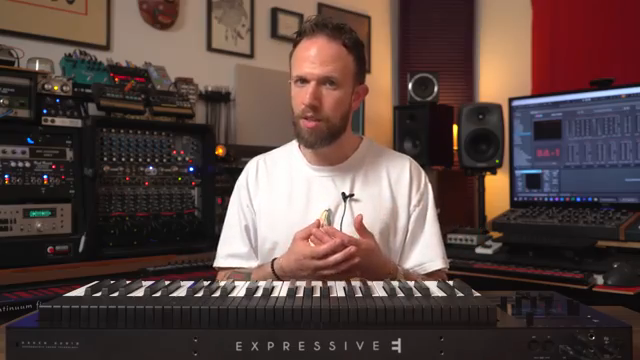
"However, using the structure of MPE, it's possible to get this non-MPE synth to have independent per-key control over pitch bend, and in this case using aftertouch to both open the filter and the drive."
© Screenshot/Quote: Expressivee (YouTube)
The tutorial wraps up by demonstrating how Osmose can inject new life into non-MPE instruments. Using Baby Audio’s BA-1 as an example, the host shows how aftertouch can be mapped to filter and drive parameters via standard MIDI learn, even without full MPE support. While per-key pitch bend is limited in single-channel mode, the video details a creative workaround: running multiple instances of the synth on separate MIDI channels to approximate per-note control.
This segment underscores Osmose’s versatility—not just as an MPE powerhouse, but as a controller that can enhance expression in legacy or simpler plugins. The workflow may be more involved, but the payoff is the ability to bring nuanced, physical performance to a broader range of software instruments.
This article is also available in German. Read it here: https://synthmagazin.at/expressive-e-osmose-mpe-expression-fuer-software-synths-entfesselt/
Watch on YouTube:
Latest articles
Watch on YouTube:
Visit the channel:
https://www.youtube.com/ExpressiveE
https://www.youtube.com/ExpressiveE
Links from ExpressiveE:
Sponsored links:
If you purchase via these links, we may earn a small commission – at no extra cost to you. The link opens an Amazon keyword search, and results may vary depending on availability.
Ableton Drift
🔗 Check price on Amazon
🔗 Check price on Amazon
Baby Audio BA-1
🔗 Check price on Amazon
🔗 Check price on Amazon
Cherry Audio DCO-106
🔗 Check price on Amazon
🔗 Check price on Amazon
Legend HZ by Synapse Audio
🔗 Check price on Amazon
🔗 Check price on Amazon
Myth by Dawson
🔗 Check price on Amazon
🔗 Check price on Amazon
Noisy 2
🔗 Check price on Amazon
🔗 Check price on Amazon
Osmose
🔗 Check price on Amazon
🔗 Check price on Amazon
Phase Plant
🔗 Check price on Amazon
🔗 Check price on Amazon
Vital
🔗 Check price on Amazon
🔗 Check price on Amazon