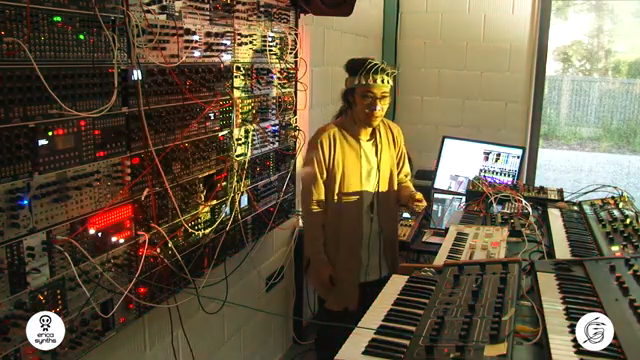
What happens when you wire up a human brain to a wall of modular synths? Erica Synths’ Garage hosts composer and researcher Jachin Pousson for a live demonstration that’s equal parts neuroscience and patching wizardry. Using Brain-Computer Music Interfacing (BCMI), Pousson manipulates a quartet of synthesizers with his EEG signals, letting his emotional state and focus modulate tempo, effects, and even the room’s lighting. This performance isn’t just a technical showcase—it’s a glimpse into the future of expressive, biofeedback-driven modular music, all set against Erica Synths’ signature backdrop of dark, exploratory sound.
30. January 2025
MILES
Erica Synths: Brainwaves Meet Patch Cables – Jachin Pousson’s BCMI Performance at the Garage
Neurons, Wires, and Modular Dreams
Jachin Pousson’s performance at the Erica Synths Garage isn’t your average patch-and-play session. Instead, it’s the culmination of years spent exploring the intersection of neuroscience and modular synthesis, with Pousson plugging his brain directly into the modular system via EEG. The idea is as simple as it is radical: brain voltage becomes control voltage, turning the performer’s mental state into a live patching tool.
This isn’t a one-off experiment, but the result of five years of research at the Latvian Music Academy, where Pousson and collaborators have been developing brain-computer interfaces for musical performance. The approach is hands-on and iterative, with each new participant requiring custom threshold calibration to translate their unique brain signals into meaningful synth control. The result is a live setup where neurofeedback isn’t just a novelty, but a genuine creative force shaping the music in real time.
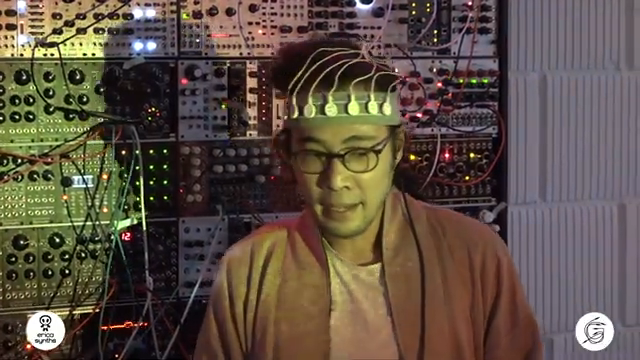
"The EEG measures voltage and voltage controls synthesizers."
© Screenshot/Quote: Ericasynths (YouTube)
Real-Time Mind Control: The Modular Setup
"On the screen here, I've got 16 parameters, which are decoded from my brain waves."
© Screenshot/Quote: Ericasynths (YouTube)
The heart of Pousson’s rig is a quartet of synthesizers, each mapped to different voices originally conceived for classical ensembles. What sets this performance apart is the real-time manipulation of these synths using brain signals, captured via EEG and decoded into 16 distinct parameters. These parameters are routed to control effects, with Pousson’s brainwaves acting like a living MIDI controller—one that’s as unpredictable as it is expressive.
A key technical challenge lies in setting the correct thresholds for each performer, as excitement or nervousness can throw the calibration off just before a show. Pousson describes the process as a delicate balance, requiring constant adjustment to ensure the brain’s influence remains musical rather than chaotic. The modular system itself is a playground, with Erica Synths’ studio providing a veritable museum of vintage and modern gear, all ready to be commandeered by neural impulses.
The result is an immersive sound environment where the performer’s emotional state and focus are directly mapped to sonic parameters. Some aspects remain under manual control, while others are left to the whims of the brain, creating a feedback loop between mind, machine, and audience. It’s a setup that blurs the line between performer and instrument, making the modular wall feel almost sentient.
From Accordions to Arpeggiators: Adapting Classical Works
Pousson’s set features extended versions of two compositions: “Circuitry” and “Downhill Ski.” Both pieces were originally written for classical ensembles—four accordions and two cellos for the former, two pianos and two marimbas for the latter—but have been reimagined for modular synthesis. The mapping is literal: each of the four synths stands in for an original instrument, preserving the structural interplay while opening up new timbral possibilities.
Despite the shift in instrumentation, the essence of the compositions remains intact. “Circuitry” leans heavily on arpeggiators and analog textures, echoing its initial inspiration from synthesizer sounds. “Downhill Ski,” on the other hand, is all about flow and coordination, mirroring the experience of navigating a complex modular patch or, as Pousson puts it, the sensation of a skier racing downhill. The modular adaptation isn’t just a technical exercise—it’s a creative translation that leverages the strengths of both worlds.
Brainwaves as Modulators: Creative Workflows in Action
One of the most striking aspects of the performance is how brain activity is mapped to key musical parameters. For instance, tempo is directly controlled by Pousson’s mental state, leading to subtle (and sometimes not-so-subtle) fluctuations that mirror his focus and excitement. He likens the experience to playing with a drummer who can’t quite keep steady time—a challenge, but also a source of organic unpredictability.
Beyond tempo, the brain’s influence extends to effects and even the lighting in the room. The EEG data is decoded and routed through a MIDI-to-CV interface, allowing Pousson’s brainwaves to modulate effects in real time. The lighting system, meanwhile, shifts between red and blue based on expressive intent, with red indicating intensity and blue signaling calm—a visual feedback loop that mirrors the music’s emotional arc.
This dynamic interplay between performer and technology highlights the potential of BCMI in live modular performance. The system is sensitive enough to respond to shifts in attention and emotion, yet robust enough to withstand the inevitable noise and unpredictability of live EEG data. It’s a workflow that demands both technical finesse and a willingness to embrace the unknown, pushing the boundaries of what’s possible in the modular realm.
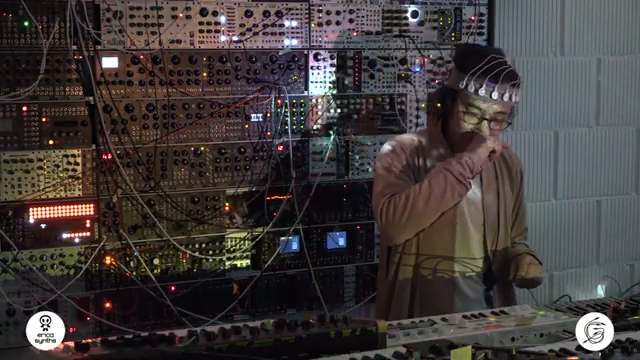
"The main parameter that my brain is mapped to in this case is the tempo."
© Screenshot/Quote: Ericasynths (YouTube)
This article is also available in German. Read it here: https://synthmagazin.at/erica-synths-gehirnwellen-treffen-patchkabel-jachin-poussons-bcmi-performance-im-garage/
Watch on YouTube:
Latest articles
Watch on YouTube:
Visit the channel:
https://www.youtube.com/EricaSynths
https://www.youtube.com/EricaSynths
Links from EricaSynths:
website: https://www.ericasynths.lv
instagram: https://instagram.com/ericasynths
facebook: https://www.facebook.com/ericasynths
twitter: https://x.com/ericasynths
Sponsored links:
If you purchase via these links, we may earn a small commission – at no extra cost to you. The link opens an Amazon keyword search, and results may vary depending on availability.
EEG Brain-Computer Interface
🔗 Check price on Amazon
🔗 Check price on Amazon
Erica Synths Modular System
🔗 Check price on Amazon
🔗 Check price on Amazon