Tim Shoebridge dives headfirst into the Dreadbox Artemis, a flagship analog polysynth that’s got more twos than a bingo night. If you’re after classic Dreadbox grit, stereo spread, and an effects section that’s anything but polite, this one’s for you. Tim’s signature straight-talking style cuts through the hype, weighing up the Artemis’s strengths, quirks, and price tag with the kind of honesty we love. Is this synth a future classic or just another pretty face? Read on, but don’t expect any sugar-coating.
2. January 2026
SPARKY
Dreadbox Artemis: Tim Shoebridge’s Double-Barrelled Polysynth Review
Two of Everything: The Artemis Arsenal
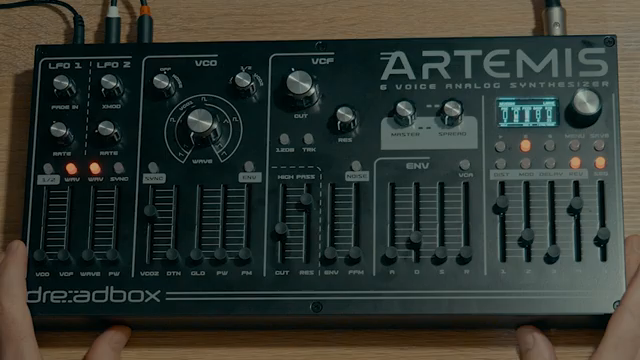
The Dreadbox Artemis doesn’t mess about—it’s got two VCOs, two VCFs, two envelopes, and two LFOs. That’s right, it’s Noah’s Ark for synth nerds. Tim Shoebridge wastes no time showing off this symmetry, making it clear that the Artemis is built for people who want options, not limitations. The front panel is a playground for anyone who likes to get their hands dirty with sound design, and the layout makes sense even if you’re running on three hours’ sleep after a warehouse party.
Both oscillators come loaded with classic waveforms—saw, square, and triangle—and you can blend between them with a single knob. There’s a sub-oscillator and noise source thrown in for good measure, plus frequency modulation and detuning that let you dial in everything from subtle movement to full-on chaos. The detune behaviour is a bit one-sided (only VCO2 gets sharp), but if you’re into FM and hard sync, this thing’s got you covered. The Artemis doesn’t just tick boxes—it double-ticks them.

"It's a two-of-everything synthesizer. There are two VCOs, there are two VCFs, there are two envelope generators, there are two LFOs."
© Screenshot/Quote: Timshoebridge (YouTube)
Classic Dreadbox DNA: Oscillators, Filters & Modulation Mayhem
If you’ve played with Dreadbox gear before, you’ll recognise the sound straight away. The oscillators and filters ooze that signature warmth and character—think vintage but not crusty. Tim highlights the 24dB low-pass filter with its juicy resonance and self-oscillation, plus a high-pass filter that’s not just an afterthought. Having both in series is a nod to legends like the Jupiter-8 and CS-80, and the high-pass is even resonant (rare enough to make filter geeks smile).
Modulation is where things get spicy. You get dedicated envelopes for both filter and amp, snappy as you like, and LFOs that can double as envelopes. There’s FM between oscillators, PWM, and plenty of ways to twist your sound into new shapes. The only catch? The high-pass filter can’t be modulated by the onboard LFOs or envelopes—just the mod wheel or aftertouch. Still, for most classic and experimental moves, Artemis brings the goods.
Effects Section: Not Just a Tacked-On Afterthought

"It's as much about the effects as it is about the raw sound."
© Screenshot/Quote: Timshoebridge (YouTube)
Here’s where Artemis flexes: the effects section is lifted straight from the Typhon and it’s a monster. Four groups—distortion, modulation, delay, and reverb—each with multiple algorithms, from the bread-and-butter to the properly bonkers. Tim’s not shy about saying this is a standout feature, and he’s right. The effects aren’t just there for show; they transform the synth into a proper sonic street weapon.
You can go from lush and dreamy to glitchy and rude in seconds. The effects are digital, but who cares when they sound this good? If you’re the type who thinks effects should be left to the DAW, Artemis might change your mind. Tim reckons the effects are as much a part of the synth’s identity as the analog core, and after hearing the demos, I’m inclined to agree. For the full impact, though, you’ll want to check out the video—words don’t do the weird stuff justice.
No Mod Matrix: Flexibility Takes a Hit
Now for the elephant in the rave bunker: there’s no modulation matrix. Tim calls this the Artemis’s biggest shortfall, and he’s not wrong. You can’t route LFOs or envelopes to every parameter under the sun—what you see on the panel is what you get. Want to modulate the high-pass cutoff with an LFO? Tough luck. The mod wheel and aftertouch can do some workarounds, but it’s not the same as a proper mod matrix.
This limitation might not bother purists who love a hands-on, immediate interface, but if you’re coming from synths that let you patch anything to anything, you’ll feel the squeeze. The menu system is dead simple—one layer deep and not a labyrinth—but don’t expect modular-level flexibility. For some, this is a dealbreaker; for others, it’s just part of the Artemis’s character. Either way, it’s something you’ll want to chew over before dropping cash.
"The Artemis doesn't have a mod matrix. There's nowhere in the menu system where you can choose an LFO or an envelope and say it's going to modulate the high pass filter cutoff, for example."
© Screenshot/Quote: Timshoebridge (YouTube)
Price Wars: Artemis vs. The Dreadbox Family

"To be honest with you, I see negativity over the cost of anything at the moment, and I think that's a real shame."
© Screenshot/Quote: Timshoebridge (YouTube)
Let’s talk money, because everyone else is. The Artemis sits in the mid-priced bracket, and Tim doesn’t dodge the controversy. Compared to the Nymphes, it’s almost three times the price, and that’s got people grumbling. But stack it up against other analog polysynths—especially boutique or flagship models—and it starts to look pretty reasonable. Dreadbox have a synth for every wallet: Nymphes for the budget crowd, Artemis in the middle, and the Murmux Adept for those with deep pockets (if you can even find one).
The real question: are the extra features on Artemis—like the dual VCOs, effects, arpeggiator, and polyphonic sequencer—worth the jump in price over the Nymphes? That’s down to you. Tim’s take is balanced: he loves the sound, interface, and effects, but admits the price will sting for some. If you want a flagship Dreadbox with all the trimmings, Artemis is worth a serious look. If you’re counting pennies, the Nymphes might be the better street weapon.
This article is also available in German. Read it here: https://synthmagazin.at/dreadbox-artemis-tim-shoebridge-packt-den-doppel-polysynth-aus/
Watch on YouTube:
Latest articles
Watch on YouTube:
Visit the channel:
https://www.youtube.com/TimShoebridge
https://www.youtube.com/TimShoebridge
Links from TimShoebridge:
Instagram: https://instagram.com/soundmangling/
Sponsored links:
If you purchase via these links, we may earn a small commission – at no extra cost to you. The link opens an Amazon keyword search, and results may vary depending on availability.
Dreadbox ARTEMIS
🔗 Check price on Amazon
🔗 Check price on Amazon