In the hands of David Hilowitz Music, the kyogum—a traditional Korean harp—becomes more than an artifact; it’s a vessel of memory, resonance, and reinvention. This video is not just a restoration, but a poetic journey through dust, silk, and digital echoes, where each string is a filament of history and possibility. Hilowitz’s signature blend of curiosity and technical artistry guides us from thrift store serendipity to the shimmering threshold between acoustic and synthesized sound. The story unfolds like a foggy morning, revealing both the tactile beauty of wood and string, and the magnetic allure of sonic transformation. Prepare to drift inside a world where tradition and invention entwine, and the kyogum exhales new life.

14. February 2026
LUMINA
David Hilowitz Music: Breathing New Life into the Kyogum’s Sonic Ghosts
3D Printer, Decent Sampler, Kyogum (Gayageum), Kyogum Synthesizer Engine
Resurrecting the Kyogum: A Thrifted Relic’s Awakening
The journey begins in the labyrinthine aisles of Thunderbird Salvage, where the kyogum—long, battered, and enigmatic—waits in silent anticipation. Its presence is spectral, a whisper from another world, half-strung and tangled in the detritus of time. David Hilowitz, ever the sonic explorer, is drawn to its neglected form, sensing the latent stories coiled within its silk and wood.
Back in the studio, the kyogum’s true scale is revealed—a vessel so expansive it demands a wide-angle lens to capture its full silhouette. Six strings cling to the body, while the others dangle, unmoored. The wood, parched and faded, drinks in polish like a desert after rain, darkening as if memory itself is seeping back into the grain. This is not just repair; it is a ritual of restoration, where every gesture is a dialogue with the instrument’s past and the ghosts it carries.
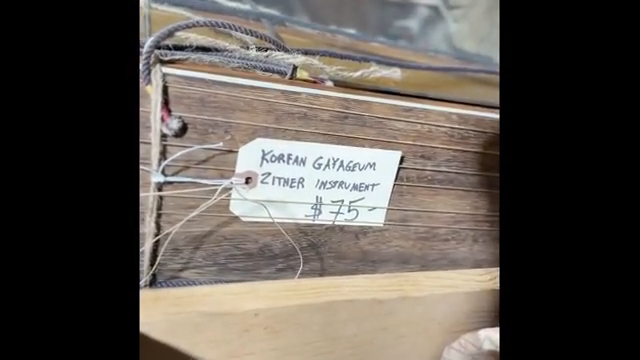
"This instrument is called the kyogum, and yes, it's a 12 string harp from Korea."
© Screenshot/Quote: Davidhilowitzmusic (YouTube)
Plastic Bridges and Printed Pawns: 3D Printing Meets Tradition
"Here you are, faced with this really cool new piece of technology. It's easy to fall into the trap of thinking any problem can be solved with the printer."
© Screenshot/Quote: Davidhilowitzmusic (YouTube)
With bridges and pegs lost to history—and replacements from Korea prohibitively expensive—the kyogum’s voice is trapped in silence. Enter the 3D printer, a modern conjurer’s tool found discarded and reborn for this mission. Hilowitz, new to the alchemy of fused filament, dives into design, drafting bridges in Fusion 360 and coaxing them into existence layer by layer. Each bridge is a tiny sculpture, a plastic archway for resonance to cross.
The process is tactile and iterative: bridges are printed, tested, and multiplied, while pegs—shaped like chess pawns—are engineered to anchor the silk. The tactile ritual of threading, knotting, and tensioning becomes a meditation on invention. The kyogum, once a relic, now bristles with hybrid identity—wood, silk, and plastic entwined, tradition and technology in magnetic resonance.
Tuning the Past: Wrestling with Silk and History
Tuning the kyogum is an act of patience and surrender. Its strings, spun from silk that may be half a century old, resist easy alignment. The instrument’s design—part ancient engineering, part improvisation—demands a dance between rope tension, bridge position, and the subtle twist of 3D-printed tolkei pegs. Each attempt to reach the correct pitch is a negotiation with fragility; strings snap, knots are retied, and the process repeats in a cycle as old as the instrument itself.
The search for the right tuning becomes a journey through time and culture. Research unearths the kyogum’s sanjo variant, a lineage rooted in 19th-century Korean music. Videos and PDFs become guides through this labyrinth, revealing that tuning is not just technical but historical—a living tradition shaped by hands, ears, and the slow drift of centuries. The kyogum’s voice emerges, pentatonic and pure, a scale where every note blooms in the right key, inviting us to listen for the echoes of its origins.
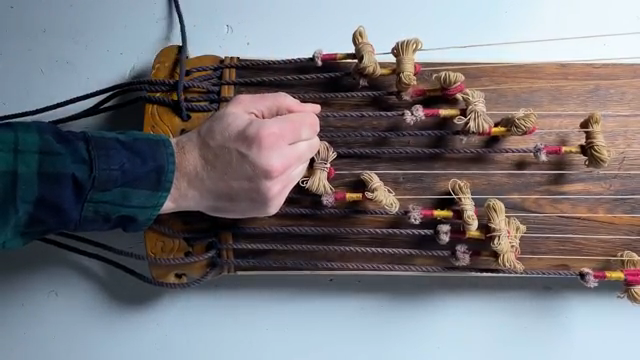
"First, tuning by simply pulling on these ropes is very inaccurate. And second, and much more important, it's too much tension, the strings just keep breaking."
© Screenshot/Quote: Davidhilowitzmusic (YouTube)
Resonant Echoes: The Kyogum Sings Again

"What a beautiful sounding instrument."
© Screenshot/Quote: Davidhilowitzmusic (YouTube)
When the kyogum finally sings, its sound is a bloom of fog and fractured light. Each pluck releases a nebula of overtones, the silk strings humming with both vulnerability and strength. The pentatonic tuning makes every gesture feel intentional, every note a ripple in a tranquil pond. Drums join in, and suddenly the room is filled with the scattered melodies of sanjo—music that drifts and gathers like morning mist.
Hilowitz’s playing is exploratory, meditative, and deeply tactile. Vibrato shivers through the strings, and even the simplest phrases become miniature stories. The kyogum’s timbre is both ancient and immediate, a sonic ghost shimmering between worlds. Sampling and digital manipulation in Ableton extend its reach, transforming fleeting moments into loops that pulse with new possibility.
Yet, the true magic is in the tactile, embodied encounter—fingers on silk, wood resonating beneath the hand. Some nuances, the magnetic pull of resonance and the subtle interplay of harmonics, can only be felt by watching and listening. The video itself becomes a portal, inviting us to witness the kyogum’s rebirth in real time.
From Silk to Silicon: The Kyogum Synthesizer Engine
The journey does not end with the acoustic. Inspired by research and restless curiosity, Hilowitz conjures a digital twin—a synthesizer engine modeled after the kyogum’s architecture. Using Karplus-Strong synthesis, this engine seeks to capture the essence of plucked silk, allowing bridges to be moved and tunings to shift in a landscape of code. The result is not a perfect replica, but a new instrument, shimmering with its own spectral identity.
This digital kyogum lives inside Decent Sampler and as a VST, open source and free to explore. It is an invitation to drift between worlds, to let the boundaries of wood and wire dissolve into magnetic resonance. For those who wish to feel the full bloom of this transformation, the video’s sound and presence offer an experience that words can only hint at—a sonic ghost, reborn in both flesh and code.
This article is also available in German. Read it here: https://synthmagazin.at/david-hilowitz-music-wie-der-kyogum-seine-klanggeister-neu-atmet/
Watch on YouTube:
Latest articles
Watch on YouTube:
Visit the channel:
https://www.youtube.com/DavidHilowitzMusic
https://www.youtube.com/DavidHilowitzMusic
Links from DavidHilowitzMusic:
David Hilowitz Web Site: https://davidhilowitz.com
Contact Form: https://davidhilowitz.com/contact
facebook: https://facebook.com/davidhilowitz
Sponsored links:
If you purchase via these links, we may earn a small commission – at no extra cost to you. The link opens an Amazon keyword search, and results may vary depending on availability.
3D Printer
🔗 Check price on Amazon
🔗 Check price on Amazon
Decent Sampler
🔗 Check price on Amazon
🔗 Check price on Amazon
Kyogum (Gayageum)
🔗 Check price on Amazon
🔗 Check price on Amazon
Kyogum Synthesizer Engine
🔗 Check price on Amazon
🔗 Check price on Amazon