Behringer has a reputation for shaking up the status quo, and with the Ring Stinger, they’re aiming their sonic disruptor squarely at guitarists, synth heads, and producers who crave something unruly. In their latest video, Behringer introduces this pedal as a wild, rule-breaking addition to their lineup, promising a blend of ring modulation and octave fuzz that’s anything but polite. With a bold metal enclosure, a forest of knobs and switches, and CV/expression pedal integration, the Ring Stinger is pitched as a tool for those who want to push boundaries—on stage or in the studio. We take a closer look at what Behringer’s official demo reveals about this analogue beast and how it might fit into your creative signal chain.

12. February 2026
MILES
Behringer’s Ring Stinger: Analogue Mayhem in a Metal Box
Breaking the Mould: The Ring Stinger Arrives
Behringer wastes no time in positioning the Ring Stinger as a pedal that’s here to disrupt. The video opens with a tongue-in-cheek warning for guitarists, synth players, and producers to brace themselves for a physical and emotional experience—one that’s both a nod to the past and a shot of something new. The Ring Stinger is introduced as a reimagining of a 90s classic, a device that once upended the pedal world and has since become elusive on the second-hand market.
The narrative leans into the idea that this pedal isn’t just another sensible addition; it’s a deliberate act of rule-breaking. Behringer’s presentation style is as bold as the pedal’s name, promising an experience that’s more than just a reissue. The Ring Stinger is cast as a walk on the wild side, designed to leave a lasting impression on anyone who dares to plug in.
"They took the rules and used them as toilet paper."
© Screenshot/Quote: Behringer (YouTube)
Ring Mod Meets Octave Fuzz: A Sonic Firestorm
"Simply saying it's a ring modulator with octave fuzz is not doing this box the justice it deserves."
© Screenshot/Quote: Behringer (YouTube)
At its core, the Ring Stinger combines two unruly effects: a ring modulator and an octave fuzz. But as the video’s host points out, simply calling it that barely scratches the surface. This is not a polite, background effect—think more Carolina Reaper than black pepper. The pedal is pitched as the box you reach for when you want to inject serious chaos into your signal path.
The sound character is described as wild and experimental, with the ability to push your tone into alien territory. The demo hints at the sort of unpredictable, harmonically rich textures that only analogue ring modulation and fuzz can deliver, inviting users to explore beyond familiar sonic ground.
Knobs, Switches, and Metal: The Hardware Up Close
Visually, the Ring Stinger is a feast for the eyes, with a striking metal enclosure and a generous array of controls. The design pays homage to its 90s ancestor, with bold graphics and colours that stand out on any pedalboard. The multitude of knobs and switches signals serious intent—this is a pedal for those who want to get hands-on with their sound shaping.
Behringer highlights the fully analogue signal path and the attention to detail from their engineers and testers. The pedal’s build is described as solid and gig-ready, with the tactile interface inviting experimentation. It’s clear that the Ring Stinger is meant to be tweaked in real time, whether you’re on stage or in the studio.
Expression and CV: Modulation on Tap
For those who like to manipulate sound on the fly, the Ring Stinger offers both expression pedal and CV inputs. These allow for real-time control over parameters like LFO depth and VCO frequency, opening up a world of performance possibilities. The video points out that while synth players can twist knobs directly, guitarists and bassists can use external controllers to keep both hands on their instrument.
This integration makes the Ring Stinger more than just a static effect—it becomes a dynamic tool for live modulation. Whether you’re sweeping frequencies mid-riff or automating changes from a modular rig, the pedal’s connectivity encourages interactive sound design.
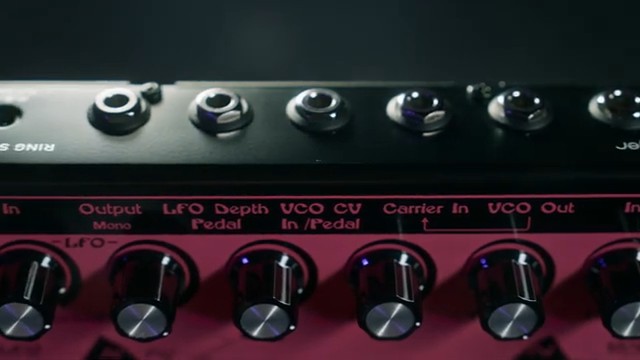
"You can plug in an expression pedal or CV to control LFO depth and change the VCO frequency."
© Screenshot/Quote: Behringer (YouTube)
From Stage to Studio: Creative Chaos Unleashed
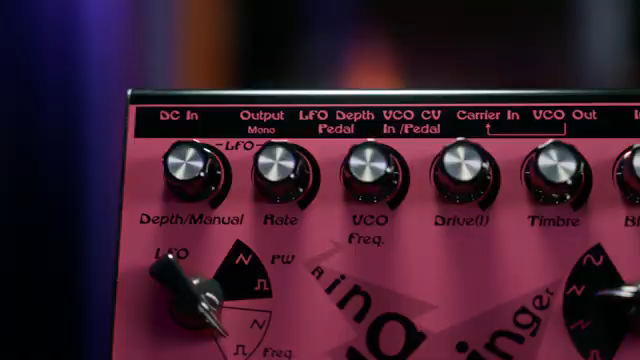
"It's more about experimenting, exploring and unlocking new sounds rather than trying to recall sounds you've already heard."
© Screenshot/Quote: Behringer (YouTube)
The Ring Stinger isn’t just for the stage; its versatility shines in the studio as well. The input section is described as highly accommodating, inviting users to plug in a variety of sources and see what emerges. The video demonstrates using a kick drum to trigger a sine wave via the carrier input, creating effects that lock to your production’s timing.
Behringer’s host emphasises that the controls may seem unconventional, but that’s by design—the pedal is about exploration, not recall. With a quick start guide offering detailed control breakdowns and preset ideas, the Ring Stinger is positioned as a catalyst for creativity, pushing musicians to discover new sounds rather than repeat old ones.
This article is also available in German. Read it here: https://synthmagazin.at/behringer-ring-stinger-analoge-klang-anarchie-im-metallgehaeuse/
Watch on YouTube:
Latest articles
Watch on YouTube:
Visit the channel:
https://www.youtube.com/behringer
https://www.youtube.com/behringer
Links from behringer:
website: https://www.behringer.com
facebook: https://www.facebook.com/Behringer
twitter: https://twitter.com/BEHRINGER
instagram: https://instagram.com/Behringer
Sponsored links:
If you purchase via these links, we may earn a small commission – at no extra cost to you. The link opens an Amazon keyword search, and results may vary depending on availability.
Behringer Ring Stinger
🔗 Check price on Amazon
🔗 Check price on Amazon