Behringer steps into the dual filter arena with Swords, a Eurorack module inspired by Mutable Instruments Blades and built around analog 2164 circuitry. On their official channel, Behringer showcases Swords’ ability to morph between filter modes, link for stereo or series operation, and deliver everything from subtle tone shaping to aggressive, modulated textures. The video highlights not just the technical specs, but also the module’s musicality—especially its self-oscillation and drive capabilities. For those who crave hands-on control and patchable flexibility, Swords looks set to carve out a place in many racks.
5. December 2024
MILES
Behringer Swords: Dual Morphing Filters for Modular Adventurers
Swords: Dual Analog Filtering with a Modular Edge
Behringer’s Swords module enters the Eurorack landscape as a dual analog filter designed to expand the tonal palette of any modular setup. The video wastes no time in positioning Swords as a contender for the stereo analog filter crown, with a nod to its state-of-the-art circuitry based on the classic 2164 semiconductors. This focus on analog design is very much in line with Behringer’s usual approach, offering accessible hardware with a vintage-inspired heart.
The module is presented as a tool for both subtle and extreme sound shaping. Whether you’re after gentle spectral tweaks or more radical filter-based transformations, Swords is pitched as a flexible addition to your rack. The emphasis on stereo operation and precise control hints at a module that’s just as comfortable in a live performance rig as it is in the studio.
Morphing Filters: From Low Pass to High Pass and Beyond
At the core of Swords are two 12 dB state variable filters, each capable of continuously morphing between low pass, band pass, and high pass responses. This isn’t your grandad’s static filter—morphing allows for smooth transitions and evolving timbres, which can be a goldmine for dynamic patches and animated textures.
The video highlights how this morphing behaviour opens up a spectrum of tonal possibilities. By blending filter modes on the fly, users can sculpt sounds that move fluidly between classic filter types, making Swords a versatile tool for everything from subtle movement to dramatic sweeps.
CV Control: Every Parameter at Your Fingertips
One of Swords’ headline features is its full CV control over all parameters. This means you can modulate cutoff, resonance, morphing, drive, and routing—all from external sources. For modular purists and patching enthusiasts, this opens up a playground of possibilities, from classic filter sweeps to complex, evolving modulations.
The video demonstrates how this flexibility translates into sound: you can achieve everything from smooth, liquid filtering to aggressive, distorted FM-style textures. The ability to push resonance to self-oscillation without losing low end is particularly notable, giving Swords a musical edge in both subtle and extreme applications.

"Every parameter is CV controllable."
© Screenshot/Quote: Behringer (YouTube)
Customisable Routing: Stereo Linking and Serial Processing
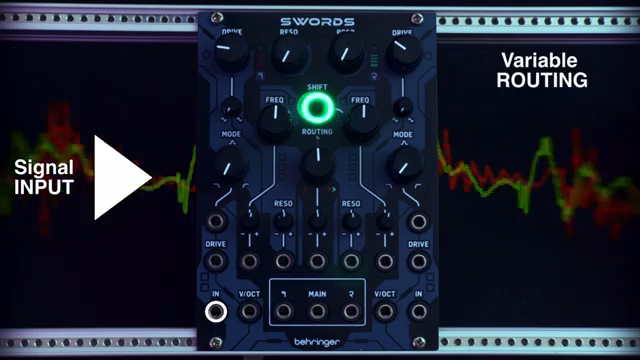
"You also have complete control over the stereo field, thanks to the continuously variable routing from single to parallel and serious sound path."
© Screenshot/Quote: Behringer (YouTube)
Routing is where Swords gets especially interesting. The module allows you to link the two filters for precise stereo control—ideal for widening your soundstage or creating spatial effects. Alternatively, you can route the filters in series, sending the output of one directly into the other for layered processing and more complex timbres.
The video shows how this routing flexibility can be dialled in continuously, not just switched. This means you can morph between single, parallel, and serial configurations in real time, giving you hands-on control over the signal path and making Swords a powerful tool for experimental patching.
Patch Examples: Self-Oscillation, CV Tricks, and Sonic Mayhem
The demonstration section dives into a series of patches that showcase Swords’ musical range. First up, a drum loop is fed through the filters, with the drive cranked and the filters linked for stereo manipulation. The presenter tweaks the left-right channels, explores filter states, and flips the stereo image, all while crushing the signal with various drive settings.
Next, the filters are routed in series, with filter one pushed into self-oscillation and filter two acting as a wavefolder. The patch is modulated using envelopes and sequencer CVs, and the main output is even used to modulate filter two’s mode—a classic bit of modular cross-patching that results in gritty, animated textures.
Finally, the video explores pinging the filters just below self-oscillation using short trigger signals. By tuning each channel and linking the filters, the presenter demonstrates how Swords can generate precise musical intervals between pings. Throughout, the emphasis is on musicality, control, and the sheer range of sounds possible when CV and drive are brought into play.

"I'll put the filter 1 in self-oscillation, with the resonance up, and I'll use the second channel as a wavefolder."
© Screenshot/Quote: Behringer (YouTube)
This article is also available in German. Read it here: https://synthmagazin.at/behringer-swords-dual-morphing-filter-fuer-modulare-klangabenteuer/
Watch on YouTube:
Latest articles
Watch on YouTube:
Visit the channel:
https://www.youtube.com/behringer
https://www.youtube.com/behringer
Links from behringer:
website: https://www.behringer.com
facebook: https://www.facebook.com/Behringer
twitter: https://twitter.com/BEHRINGER
instagram: https://instagram.com/Behringer
Sponsored links:
If you purchase via these links, we may earn a small commission – at no extra cost to you. The link opens an Amazon keyword search, and results may vary depending on availability.
Behringer Swords
🔗 Check price on Amazon
🔗 Check price on Amazon