Behringer’s HALOS steps into the Eurorack arena as a physical modeling synthesizer, promising to infuse modular systems with the organic resonance of strings, membranes, and tubes. Drawing clear inspiration from Mutable Instruments’ Rings, HALOS aims to transform unpitched triggers and audio into lush, expressive soundscapes. In this official video, Behringer walks through the module’s three resonator modes, pseudo-polyphony, and modulation capabilities, while teasing hidden features for the adventurous. For those with a taste for patching the unusual, HALOS looks set to offer both familiar textures and unexpected sonic territory.
31. July 2025
MILES
Behringer HALOS: Physical Modelling Resonance in Eurorack – An Analytical Dive
From Silence to Substance: HALOS and Physical Modelling
HALOS is introduced as a physical modeling synthesizer for Eurorack, purpose-built to bring the resonant qualities of strings, membranes, and tubes into modular setups. Rather than acting as a conventional oscillator, HALOS is a resonator that employs physical modeling synthesis to turn both internal and external unpitched signals into rich, pitched sounds. The video highlights its ability to conjure everything from plucked and strummed instruments—think harps, slide guitars, and sitars—to mallet-based tones like xylophones and tubular bells. This approach makes HALOS a versatile tool for creating organic, evolving soundscapes that respond dynamically to the nuances of modular triggers and envelopes.
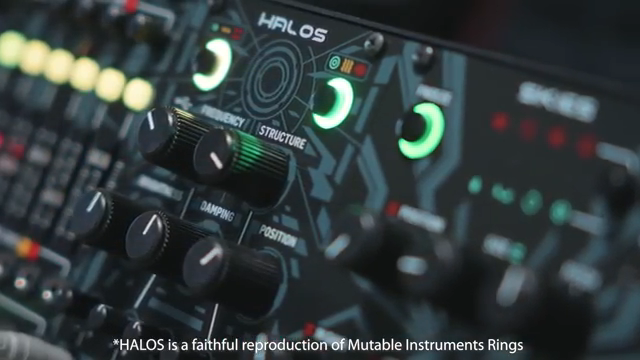
"It is in fact a full-bodied resonator that uses several physical modelling synthesis techniques to achieve its wonderful tones."
© Screenshot/Quote: Behringer (YouTube)
Three Resonator Modes: Modal, Sympathetic, and Non-linear
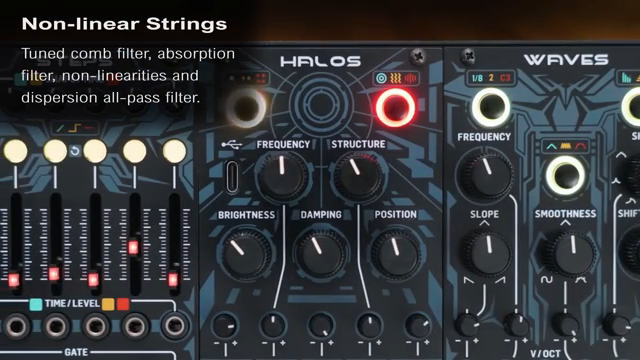
"Uses comb filtering and absorption filtering with a non-linearity and dispersion all-pass filter."
© Screenshot/Quote: Behringer (YouTube)
HALOS features three distinct resonator engines, each accessible via a colour-coded LED. The green mode, known as the modal resonator, simulates the resonance of vibrating structures such as bars, plates, and strings when struck—ideal for recreating percussive and mallet-driven timbres. This mode is particularly adept at producing the metallic and woody tones characteristic of classic physical modeling.
Switching to the yellow LED brings up the sympathetic strings engine, which focuses on the behaviour of strings that are plucked or strummed rather than struck. This mode excels at generating lush, overlapping harmonics and the subtle interactions found in acoustic string ensembles. Finally, the red mode introduces a non-linear, inharmonic strings engine. Here, comb filtering and absorption filtering are combined with non-linearity and a dispersion all-pass filter, resulting in timbres reminiscent of harpsichords and metallic bells. Each mode offers a unique palette, encouraging experimentation with both traditional and unconventional sound sources.
Pseudo-Polyphony and Parameter Control
HALOS brings pseudo-polyphony to Eurorack, a rarity in modular environments. Three polyphony modes are available: monophonic (green), two-note overlapping (yellow), and four-note overlapping (red). In monophonic mode, each new note cancels the previous, maintaining classic modular behaviour. The two-note and four-note modes, however, allow for overlapping notes, creating evolving textures and more complex harmonic interplay. This approach is particularly musical, lending itself to both melodic and ambient applications.
Parameter control is comprehensive, with dedicated knobs for frequency (pitch), brightness (harmonic content), damping (decay time), position (excitation point), and structure. The structure parameter adjusts partials in the modal mode and detuning in the sympathetic and non-linear modes. This level of control enables nuanced shaping of timbre and dynamics, making HALOS responsive to both subtle modulation and dramatic performance gestures.

"The way this has been implemented is without doubt one of the most gorgeous and musical-sounding aspects of this module."
© Screenshot/Quote: Behringer (YouTube)
Modulation and Integration: CV with Attenuverters
HALOS is designed for deep modular integration, offering CV inputs for all major parameters, each equipped with its own attenuverter. This setup allows for precise modulation, whether from sequencers, LFOs, or random sources, and encourages creative patching strategies. The volt-per-octave CV input includes a step detector, automatically applying a gate when a new note is detected—streamlining melodic sequencing.
Additional inputs include a strum input, which is especially useful in polyphonic modes to control voice allocation, and stereo odd/even outputs for flexible routing. The odd output can be used for a mono downmix, while the audio input enables external excitation sources, though this feature is set for deeper exploration in future videos. Altogether, HALOS presents a modulation-friendly architecture that should appeal to patchers seeking expressive, hands-on control.
Hidden Depths: Secret Modes Await
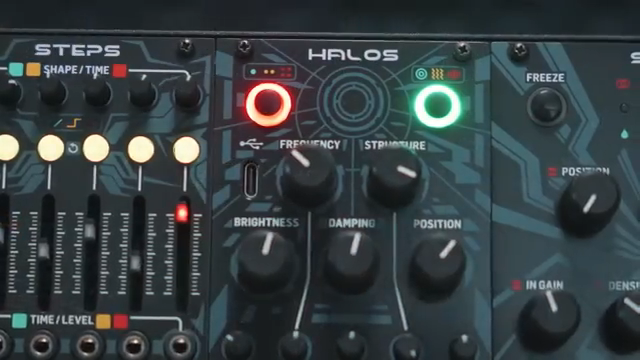
"There is actually a secret FM synth embedded in this module, if you know the secret combination."
© Screenshot/Quote: Behringer (YouTube)
The video closes with tantalising hints at hidden features lurking within HALOS. Beyond its primary resonator engines, the module reportedly houses a secret FM synthesizer, a reverb, and even an organ string machine inspired by the Roland RS09. These extras are not demonstrated here but are promised for exploration in part two. For now, Behringer leaves us with the sense that HALOS is more than meets the eye, inviting further investigation from adventurous modular users.
This article is also available in German. Read it here: https://synthmagazin.at/behringer-halos-physikalisches-resonanzmodell-im-eurorack-eine-analytische-betrachtung/
Watch on YouTube:
Latest articles
Watch on YouTube:
Visit the channel:
https://www.youtube.com/behringer
https://www.youtube.com/behringer
Links from behringer:
website: https://www.behringer.com
facebook: https://www.facebook.com/Behringer
twitter: https://twitter.com/BEHRINGER
instagram: https://instagram.com/Behringer
Sponsored links:
If you purchase via these links, we may earn a small commission – at no extra cost to you. The link opens an Amazon keyword search, and results may vary depending on availability.
Behringer HALOS
🔗 Check price on Amazon
🔗 Check price on Amazon