Behringer steps into the Eurorack sequencer arena with the BQ-10, a 24-step analog sequencer that puts hands-on control front and centre. Eschewing screens and menu-diving, the BQ-10 is all about tactile immediacy, classic workflow, and modular integration. In their official video, Behringer walks through the BQ-10’s vintage-inspired design, flexible step modes, and a host of connectivity options—including MIDI and per-step triggers—that promise to slot right into both old-school and modern modular setups. If you’re after a sequencer that’s more about patch cables than presets, this one’s worth a closer look.
11. November 2025
MILES
Behringer BQ-10: Analogue Sequencing, No Menus Required
No Menus, Just Knobs: The BQ-10’s Hands-On Philosophy
Behringer’s BQ-10 is introduced as their first foray into semi-modular sequencing, and the emphasis is clear: this is a sequencer for those who want to get stuck in without the faff of screens or endless menus. The video opens with a nod to Behringer’s recent run of semi-modulars, but the BQ-10 is positioned as a tool to bring order—and creativity—to the patching chaos.
The BQ-10’s interface is all about immediacy. With three rows of eight steps, each with its own chunky knob, the layout is designed for intuitive tweaking. There’s a tactile satisfaction in building sequences here, reminiscent of classic hardware from the late ’70s. Behringer make it clear: this is about fun, fast melodic creation, not menu navigation. The inspiration from the vintage SQ10 is obvious, but the BQ-10 brings it into Eurorack territory with a modern twist.
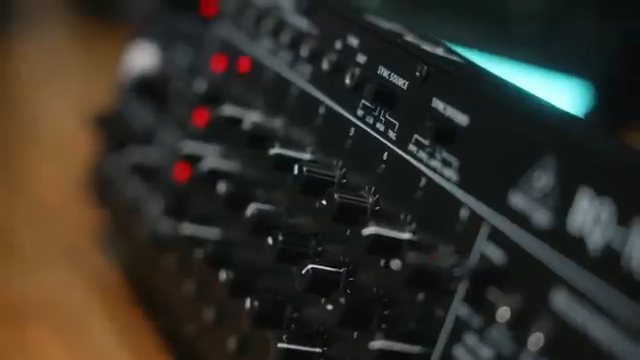
"Hands-on control, intuitive layout, zero menu diving and that satisfying tactile feel that makes building melodies and sequences fun and endlessly tweakable."
© Screenshot/Quote: Behringer (YouTube)
Step Modes and Per-Step Triggers: Creative Control Unleashed
Diving into the feature set, the BQ-10 offers both single 16-step sequences and dual 8-step modes, giving you flexibility in how you structure your patterns. Each of the three channels—A, B, and C—can be routed to different destinations in your modular setup, opening up possibilities for melodic, modulation, or filter sequencing.
A standout is the dedicated per-step trigger outputs. These allow for custom reset patterns and advanced patching tricks, such as setting unique step lengths or triggering external events. The video demonstrates patching a trigger from a specific step to the reset input, instantly changing the sequence length—a classic modular move that’s made easy here. Dedicated CV lanes mean you can control pitch, filter cutoff, or amplitude independently, all from the same sequencer.
Voltage Ranges and Connectivity: Modular Integration Sorted
"Each channel has a voltage range selector to set the control range. So you can go from 1 volt, 2 volt, 5 volt and also the Korg standard of 8 volts or hertz per volt."
© Screenshot/Quote: Behringer (YouTube)
The BQ-10 caters to a range of modular standards with selectable voltage ranges per channel—1V, 2V, 5V, and even the Korg-standard 8V (hertz per volt). This makes it a versatile partner for everything from Eurorack oscillators to vintage MS-20s and K2s. The video highlights how this flexibility is a boon for those with mixed-format setups.
Connectivity is a strong suit: each channel gets its own CV and gate outputs, and there’s USB MIDI for snapping sequences to chromatic pitches. Whether you’re clocking the BQ-10 from an external trigger, syncing via MIDI, or running it standalone, the integration options are extensive. The hands-on demonstration shows both analog and digital connections in action, underscoring the BQ-10’s role as a true modular hub.
Patching in Action: Sequences, Sync, and Sonic Evolution
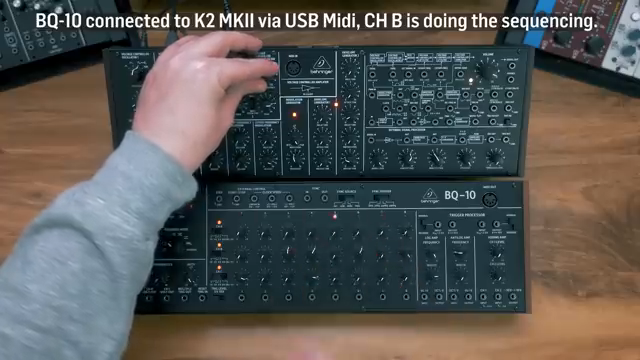
The video moves on to real-world patching, with the BQ-10 controlling a Behringer K2 synth. Sequences are dialled in live, with channel A handling pitch, channel B available for modulation, and channel C routed to filter cutoff. The ability to add portamento and adjust trigger duty cycles is demonstrated, showing how evolving, expressive patterns can be built on the fly.
Sync options are plentiful: internal clock, external triggers, USB, MIDI, and analog sync all get a look-in. The inclusion of a clock divider and a trigger processor (inspired by the MS03) means you can convert between V-trigger and S-trigger standards, as well as merge or transform voltages for more complex patches. The BQ-10’s flexibility in both sequencing and sync is a highlight, making it a creative centrepiece for evolving modular jams.
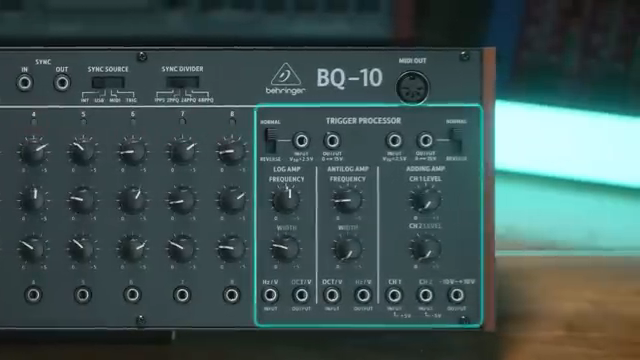
"You can easily convert between V trigger and S trigger standards and vice versa. The log amp will convert hertz per volt to octave per volt and the anti-log amp will do the opposite."
© Screenshot/Quote: Behringer (YouTube)
Vintage Vibe, Modern Workflow: The BQ-10’s Design Ethos
Behringer’s BQ-10 is clearly designed to evoke the tactile, hands-on feel of classic sequencers, but with enough modern touches to satisfy today’s modular crowd. The layout, step modes, and per-step triggers all nod to vintage gear, while MIDI, USB, and advanced sync options bring it firmly into the present.
This blend of old and new makes the BQ-10 suitable for both purists seeking that classic analog sequencing experience and those wanting to integrate with DAWs or digital rigs. The video closes by emphasising the BQ-10’s role as a bridge between eras—a sequencer that’s as happy in a vintage-inspired patch as it is at the heart of a contemporary modular setup.
This article is also available in German. Read it here: https://synthmagazin.de/behringer-bq-10-analoge-sequenzen-ohne-menues/
Watch on YouTube:
Latest articles
Watch on YouTube:
Visit the channel:
https://www.youtube.com/behringer
https://www.youtube.com/behringer
Links from behringer:
website: https://www.behringer.com
facebook: https://www.facebook.com/Behringer
twitter: https://twitter.com/BEHRINGER
instagram: https://instagram.com/Behringer
Sponsored links:
If you purchase via these links, we may earn a small commission – at no extra cost to you. The link opens an Amazon keyword search, and results may vary depending on availability.
Behringer BQ-10
🔗 Check price on Amazon
🔗 Check price on Amazon
Behringer K2
🔗 Check price on Amazon
🔗 Check price on Amazon