Behringer steps into the ring—literally—with the BM-12 Ring Modulator, a pedal that revives the spirit of a classic 2000s-era effect and injects it with modern flexibility. In this official walkthrough, the brand’s trademark blend of accessibility and sonic ambition is on full display, as Adam demonstrates how the BM-12 warps everything from guitar riffs to synth lines into metallic, alien textures. With its extensive I/O, active preamp, and modulation options, the BM-12 isn’t just for nostalgia trips—it’s a tool for anyone eager to twist their signal chain into uncharted territory. Let’s see how Behringer’s latest box of oddities wants to be patched, modulated, and generally misbehaved with.
25. July 2025
MILES
Behringer BM-12 Ring Modulator: Classic Chaos Reborn for Modern Patchers
A Modern Take on a Sonic Oddity
Behringer’s BM-12 Ring Modulator is introduced as a pedal that doesn’t just revisit a classic effect—it celebrates its weirdness. The video leans into the ring modulator’s reputation as a rare and peculiar beast, thriving in the hands of those willing to embrace the unpredictable. From the outset, we’re reminded that this effect is more than a simple tone shaper; it’s a disruptor, capable of transforming the most innocent of signals into something metallic and unrecognisable.
Tracing its roots from radio labs to the infamous Dalek voices and Tony Iommi’s legendary guitar solos, the BM-12 is positioned as a bridge between the worlds of synth and guitar. The pedal’s extensive I/O is highlighted as a key to its versatility, opening up creative possibilities for both traditional and experimental musicians. Whether you’re after the menacing chaos of classic sci-fi or the melodic mayhem of avant-garde synth work, the BM-12 aims to deliver.

"Metallic, otherworldly, it can transform melodies and chords into something completely new."
© Screenshot/Quote: Behringer (YouTube)
Drive That Never Sleeps
"What's also good to know is this works even when the pedal is bypassed."
© Screenshot/Quote: Behringer (YouTube)
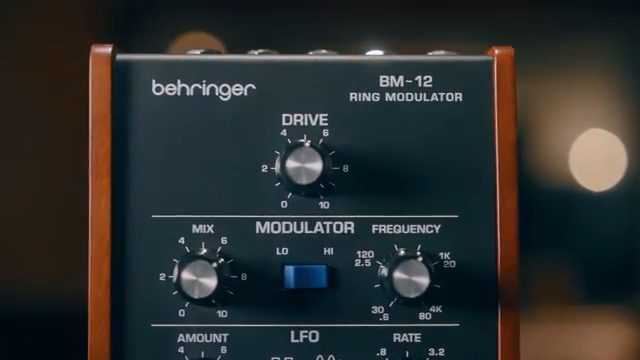
A standout feature of the BM-12 is its drive knob, which controls both signal level and saturation. The video demonstrates how this control isn’t just for when the effect is engaged—the drive circuit remains active even when the pedal is bypassed. This means the BM-12 can serve as a vibrant preamp, adding character and warmth to your signal chain regardless of whether you’re using the ring modulation itself.
For those who might only occasionally reach for ring mod, this opens up new use cases: the pedal becomes a dual-purpose tool, equally at home as a tone-shaping preamp or as a full-blown modulation monster. It’s a subtle but significant nod to real-world pedalboard and modular workflows, where utility and flexibility often trump single-minded design.
Frequency Control: From Subtle to Savage
Central to the BM-12’s sound is its frequency control, which determines the carrier frequency that interacts with your input signal. At low settings, the effect borders on tremolo, gently pulsing the sound. As the frequency increases, the pedal veers into more extreme territory, generating bell-like or metallic overtones that are anything but subtle.
A dedicated switch toggles the frequency range: the low setting spans from 0.6 Hz to 80 Hz, while the high range leaps from 30 Hz up to 4 kHz. This allows for quick jumps between understated modulation and full-on sonic assault. The video makes clear that this control is crucial for shaping the BM-12’s overall character, whether you’re after a hint of movement or a complete transformation.

"This makes the frequency control crucial for shaping the overall sound from subtle modulation effects to radical bell like or metallic sounds."
© Screenshot/Quote: Behringer (YouTube)
LFO: Modulation for the Adventurous
The BM-12 doesn’t stop at static modulation—an onboard LFO brings dynamic movement into play. The LFO can modulate the carrier frequency, introducing rhythmic or evolving changes to the effect. Users can select between square and sine wave contours, providing either abrupt or smooth modulation shapes.
This addition is particularly appealing to synth enthusiasts, but guitarists are encouraged to experiment as well. The video demonstrates how the LFO, especially in the low frequency range, can create intricate tremolo rhythms and unpredictable textures. It’s a feature that invites hands-on exploration, rewarding those willing to tweak and listen.
CV, Expression, and Patchability: The Modular Connection
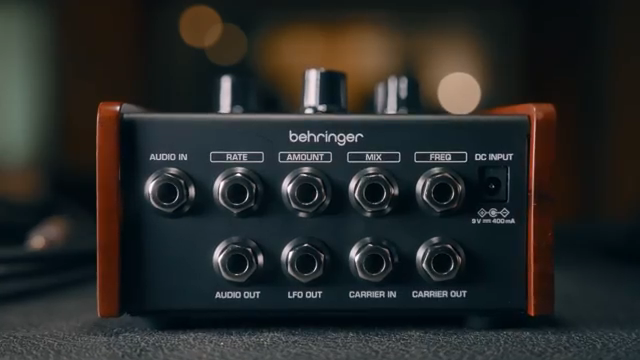
"This is going to allow you to input external control voltages or an expression pedal to manipulate parameters in the pedal."
© Screenshot/Quote: Behringer (YouTube)
Where the BM-12 truly opens up is in its support for external control voltages and expression pedals. The pedal’s rear panel allows users to input CV or expression to manipulate parameters in real time, making it a natural fit for modular synth setups or complex pedalboards. The ability to output the internal carrier signal, accept an external carrier, and send out the internal LFO further expands its integration potential.
The video showcases a patch using a Behringer Neutron’s sample and hold output to modulate the BM-12’s frequency, resulting in a randomised tremolo effect. With its robust I/O, wood side panels, and metal enclosure, the BM-12 is presented as a serious tool for sonic explorers—one that encourages experimentation and rewards creative patching.
This article is also available in German. Read it here: https://synthmagazin.at/behringer-bm-12-ring-modulator-klassisches-chaos-fuer-moderne-patch-fans/
Watch on YouTube:
Latest articles
Watch on YouTube:
Visit the channel:
https://www.youtube.com/behringer
https://www.youtube.com/behringer
Links from behringer:
website: https://www.behringer.com
facebook: https://www.facebook.com/Behringer
twitter: https://twitter.com/BEHRINGER
instagram: https://instagram.com/Behringer
Sponsored links:
If you purchase via these links, we may earn a small commission – at no extra cost to you. The link opens an Amazon keyword search, and results may vary depending on availability.
Behringer BM-12 Ring Modulator
🔗 Check price on Amazon
🔗 Check price on Amazon
Behringer Neutron
🔗 Check price on Amazon
🔗 Check price on Amazon