Arturia returns to the virtual analog arena with SEM V, a software instrument that reimagines the classic Oberheim SEM for the modern producer. This official walkthrough dives deep into SEM V’s rebuilt sound engine, expanded polyphony, and advanced modulation architecture, all wrapped in Arturia’s signature workflow-centric design. From oscillator blending to macro performance controls, the video showcases how SEM V balances vintage character with digital flexibility, making it a compelling tool for both studio sound design and live performance. If you’re curious about how Arturia’s modeling translates the SEM’s soul into a polyphonic, DAW-ready instrument, this is the overview you need.

From SEM to SEM V: Polyphony Reimagined
Arturia’s SEM V is introduced as a next-generation virtual instrument, meticulously modeled after the legendary Oberheim SEM but expanded into a full eight-voice polysynth. The video emphasizes that this isn’t just a cosmetic update—the sound engine has been rebuilt from the ground up using advanced modeling techniques. This results in a more authentic analog feel, with continuously running oscillators and envelopes that mimic hardware behavior.
The leap from the original monophonic SEM to a polyphonic, digital incarnation is central to SEM V’s identity. Arturia highlights the instrument’s ability to deliver rich, dynamic analog textures, thanks to its pair voice architecture and vintage mode. The walkthrough sets the stage by playing a range of presets, demonstrating the instrument’s sonic breadth and the expressive qualities that come from its enhanced polyphony and modulation depth.

"SEM-V is a next-generation virtual instrument that faithfully captures the sound and feel of the legendary Oberheim SEM, while expanding it into a full eight-voice poly synth with advanced modulation and performance controls."
© Screenshot/Quote: Arturiaofficial (YouTube)
Oscillators, Filters, and Modulation: The Engine Room
"And because SEM-V's LFO can reach up to 300 Hz, you can even push the FM-like territory with audio rate modulation."
© Screenshot/Quote: Arturiaofficial (YouTube)
SEM V’s sound generation starts with two voltage-controlled oscillators, now capable of smoothly blending between sawtooth and pulse waveforms—a notable expansion over the original hardware’s fixed options. Users can independently mix VCO1, VCO2, a sub-oscillator, and a noise generator, all routed into the iconic SEM filter. The ability to detune oscillators, offset pitches, and blend waveforms allows for both subtle and extreme tonal shaping.
Modulation is a core strength here. The LFO can reach up to 300 Hz for audio-rate effects, and envelopes can be assigned to oscillator pitch or pulse width for animated, evolving sounds. Oscillator sync and FM-like modulation are demonstrated, revealing the synth’s capacity for harmonically rich and edgy timbres. The filter section is equally flexible, offering continuous morphing between low-pass, notch, and high-pass, with an additional bandpass mode for focused sculpting. Filter cutoff can be modulated by envelopes, LFO, and keyboard tracking, supporting everything from acid basses to ambient sweeps.
Expressive Sound Design: Per-Voice Control and Performance Tools
A standout feature of SEM V is its per-voice architecture, which mirrors the Oberheim 8-voice legacy. Each voice can be independently controlled for level, pan, and drive, with modulation options for dynamic and expressive performances. The video demonstrates how velocity and the voice modulator can be used to spread pan and drive, creating a rich stereo image and analog-style variation across voices.
Arturia’s vintage section introduces controlled instability, letting users dial in analog drift, filter cutoff variance, and envelope timing offsets. This is managed via a single macro knob, allowing for anything from subtle warmth to wild, unstable textures. The envelope section features two ADR envelopes—one pre-routed to amplitude, the other freely assignable—offering snappy, hardware-like response. The LFO is versatile, with a wide frequency range and DAW sync capabilities, suitable for everything from vibrato to audio-rate modulation.
Polyphony and unison modes are explored, with up to eight voices per note and adjustable detune and spread for massive, wide sounds. Portamento options include both per-note and per-voice glide, catering to expressive solos and cinematic transitions. The Multi-Arp feature stands out, enabling up to four independent arpeggiator lanes with advanced pattern, rhythm, and note randomization controls—ideal for complex, evolving sequences and live performance flexibility.

"We've added per-voice control over level, pan, and drive, ideal for expressive playing and modulation."
© Screenshot/Quote: Arturiaofficial (YouTube)
Studio-Grade Effects: Sculpting the Final Sound
SEM V’s effects section is robust, offering four independent slots that can be loaded with any of 17 studio-grade effects, including delay, reverb, distortion, chorus, phaser, and multi-band compression. Each slot features its own dry/wet control, and effects can be reordered via drag-and-drop for complete signal chain flexibility.
The video demonstrates how these effects can be used for everything from subtle coloration to dramatic sound transformation. The integration of effects within the instrument’s architecture means users can shape and polish their sounds without leaving the SEM V environment, streamlining both studio and live workflows.
Macros: Streamlined Control for Dynamic Performance
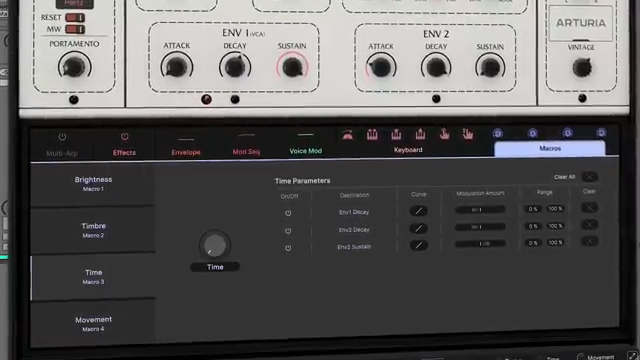
"The macro system is intuitive and flexible, making it easy to tweak, automate, or perform your sound live with precision and ease."
© Screenshot/Quote: Arturiaofficial (YouTube)
Arturia rounds out SEM V’s feature set with a flexible macro system, allowing users to assign multiple parameters to a single control. This makes it easy to perform complex changes—such as sweeping filter cutoff and adjusting effects levels—on the fly. The macro system is presented as both intuitive and powerful, supporting dynamic performance and automation without menu-diving, and ensuring SEM V adapts smoothly to a variety of creative workflows.
This article is also available in German. Read it here: https://synthmagazin.at/arturia-sem-v-digitale-wiedergeburt-der-analogen-polyphonie/
Watch on YouTube:
Latest articles
Watch on YouTube:
Visit the channel:
https://www.youtube.com/ArturiaOfficial
https://www.youtube.com/ArturiaOfficial
Links from ArturiaOfficial:
website: https://www.arturia.com
instagram: https://instagram.com/arturia_official
twitter: https://twitter.com/ArturiaOfficial
soundcloud: https://soundcloud.com/arturia-official/albums
Sponsored links:
If you purchase via these links, we may earn a small commission – at no extra cost to you. The link opens an Amazon keyword search, and results may vary depending on availability.
Arturia SEM V
🔗 Check price on Amazon
🔗 Check price on Amazon