Pigments 6 marks a bold step forward for Arturia’s flagship software synthesizer, introducing a new modal engine, expanded filters, and workflow refinements aimed at both sound designers and producers seeking deep, expressive control. In this official walkthrough, Arturia’s Lena demonstrates how the new physical modeling engine, advanced vocoder, and granular upgrades open up fresh sonic territory. With a focus on modulation, intuitive GUI tweaks, and performance-oriented features, Pigments 6 positions itself as a powerhouse for hybrid and digital-centric workflows. We explore what’s genuinely new, how these features are architected, and where the update leaves room for further exploration.
29. January 2025
LYRA
Arturia Pigments 6: Modal Synthesis, Workflow Upgrades, and a New Era for Digital Sound Design
Pigments 6: The Digital Flagship Evolves
Arturia positions Pigments 6 as its flagship software synthesizer, emphasizing versatility and innovation in sound creation. The instrument’s architecture is built around multiple synthesis engines, a robust modulation matrix, and a suite of creative effects, all topped with a sequencer designed for forward-thinking workflows. This combination aims to serve both those who want instant, mix-ready presets and those who thrive on deep, custom sound design.
The video opens with a tour of the new factory preset bank, which showcases the expanded sonic palette enabled by Pigments 6’s latest features. While the walkthrough highlights the breadth of sounds achievable, it’s clear that Arturia’s intent is to offer a platform equally suited to quick inspiration and intricate patch construction. The presentation style is typical for Arturia—direct, visually clear, and focused on demonstrating real-world results rather than abstract theory.
Modal Engine: Physical Modeling at the Core
The headline addition in Pigments 6 is the modal engine, a physical modeling synthesis module designed to simulate the behavior of real-world objects. This engine leverages two independent exciters—collision and friction—each offering multiple modes, including sample-based, real-time synthetic, granular, and external audio input. The collision exciter brings percussive energy, while the friction exciter enables sustained, evolving textures.
Central to the modal engine is its resonator section, which uses banks of resonating bandpass filters to emulate string and beam behaviors. Controls like decay, brilliance, harmonic morphing, stereo width, and bass level allow for nuanced shaping of timbre and response. The video demonstrates how these parameters interact, emphasizing the organic, responsive qualities that physical modeling brings to digital synthesis. Arturia’s approach here is both flexible and approachable, with a UI that makes complex synthesis accessible to a wide range of users.
"It is based on physical modeling synthesis which simulates physical objects with an emphasis on natural behaviors and organic response."
© Screenshot/Quote: Arturiaofficial (YouTube)
Filters, Vocoder, and Granular: Expanding the Creative Arsenal
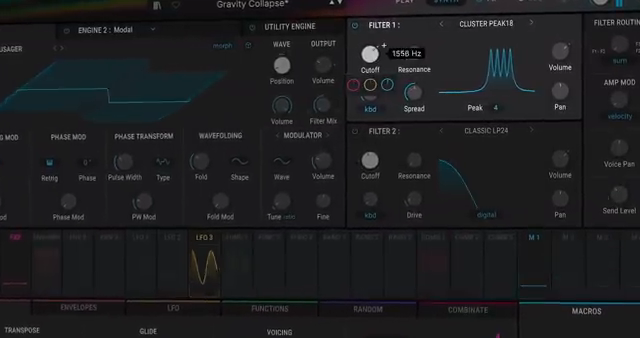
"What makes it unique is its ability to stack between one and five filters on the same cutoff point using the peak control and spread them across the frequency spectrum using the spread control."
© Screenshot/Quote: Arturiaofficial (YouTube)
Pigments 6 introduces a suite of new and enhanced features aimed at broadening its sound design capabilities. The classic filter receives a significant update, now featuring a drive control for added harmonic richness and an analog mode that maintains resonance without sacrificing loudness. The new cluster filter stacks up to five filters at once, while the lo-fi filter delivers consistent degradation across polyphonic voices, with key tracking and jitter for added character.
A major highlight is the addition of a vocoder in the FX section, enabling cross-modulation between internal engines, filters, effects, and external audio. The vocoder offers three modes and a range of controls for shaping its robotic timbres. Meanwhile, the granular engine gains a scan feature that enables time-stretch and sample-style playback effects, further expanding Pigments’ palette for experimental and modern production workflows. The video’s demonstrations make clear that these tools are designed for both subtle enhancement and radical transformation.
Workflow and Modulation: Smoother, Smarter, Deeper
Arturia has invested in workflow enhancements that streamline modulation and navigation within Pigments 6. The refreshed GUI provides clearer visual feedback and more intuitive access to key parameters. Notably, sidechain modulation is now easier to set up—users can modulate the amount of modulation itself by simply dragging and dropping a secondary modulator onto a modulation slot, facilitating complex, evolving soundscapes with minimal menu-diving.
These improvements are not just cosmetic; they directly impact how quickly and creatively users can experiment with modulation routings. The video demonstrates scenarios where LFOs modulate each other’s influence on filter cutoff, highlighting the potential for intricate, layered movement. For users who value hands-on control and rapid iteration, these workflow tweaks represent a meaningful upgrade.
Modulators: New Voices for Expressive Sound Design
Pigments 6 debuts several new modulators that open up fresh avenues for expressive sound design. The Envelope Follower, now found in the Combinate container, allows parameters to be modulated by internal or external audio signals, making dynamic, audio-reactive patches more accessible. The new Voice modulator introduces per-note variation, with up to eight distinct values that can be randomized or edited for each voice, echoing the organic imperfections of vintage synths.
Further enhancements include an upgraded Random module with Ditter, Distance, and Smooth controls, and revamped function generators with improved play modes, grids, tracers, and visual preset browsing. These additions encourage users to push beyond conventional modulation, fostering a spirit of experimentation. The video underscores how these tools can inject life and unpredictability into any patch, whether for studio production or live performance.
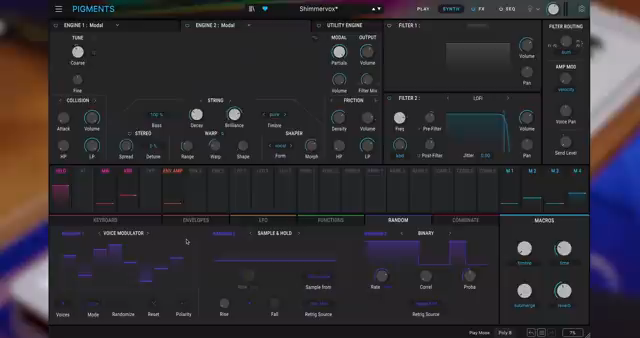
"This creates variations between voices, giving each note its own distinct character, similar to vintage synthesizers."
© Screenshot/Quote: Arturiaofficial (YouTube)
This article is also available in German. Read it here: https://synthmagazin.at/arturia-pigments-6-modale-synthese-workflow-upgrades-und-eine-neue-aera-des-digitalen-sounddesigns/
Watch on YouTube:
Latest articles
Watch on YouTube:
Visit the channel:
https://www.youtube.com/ArturiaOfficial
https://www.youtube.com/ArturiaOfficial
Links from ArturiaOfficial:
website: https://www.arturia.com
instagram: https://instagram.com/arturia_official
twitter: https://twitter.com/ArturiaOfficial
soundcloud: https://soundcloud.com/arturia-official/albums
Sponsored links:
If you purchase via these links, we may earn a small commission – at no extra cost to you. The link opens an Amazon keyword search, and results may vary depending on availability.
Arturia Pigments 6
🔗 Check price on Amazon
🔗 Check price on Amazon