ALM TV takes us on a deep dive into the Turismo, their flagship Eurorack modular workstation, demonstrating just how far this system can stretch beyond beats and grooves. In this video, the team synthesizes an entire rainstorm—raindrops, thunder, and all—using only the modules and utilities within the Turismo. The focus is on patching techniques, clever use of noise and filtering, and layering to create convincing environmental soundscapes. For those who think modular is just for techno, this is a masterclass in using ALM’s toolkit for detailed sound design and cinematic textures.

Turismo: More Than Just a Groovebox
The Turismo is introduced as a flexible Eurorack modular workstation, brimming with both analogue and digital modules. While its reputation as a sequencing powerhouse and groovebox is well established, ALM TV makes it clear that the system is equally at home in more experimental, unstructured sonic territory.
This versatility is the foundation for the video’s exploration, as the team sets out to use the Turismo for environmental sound design. The promise is to synthesize a convincing rain and thunder environment from scratch, entirely within the system’s own architecture—no samples, just pure patching ingenuity.

"Though it is well suited for sequencing beats and groovebox style patching, the versatile system fits equally well into less structured environments."
© Screenshot/Quote: Busycircuits (YouTube)
Synthesizing Rain and Thunder: The ALM Approach
Diving straight into the patch, the team begins with a rain sound, using the Tasm O module as the initial source. This is routed through the MCF x2’s bandpass filter, then on to the Megatang, establishing the core signal path for the rain texture. The use of bandpass filtering is highlighted as a natural way to mimic the spectral qualities of real-world sounds.
Noise is a key ingredient here, with the Megamilton’s white noise generator providing the chaotic element essential for realistic rain. By duplicating the noise signal via the Malt and using one copy to amplitude modulate the Tasm O, the patch immediately gains a crackling, raindrop-like quality. Parameter tweaks on both the oscillator and filter allow for fine control over the character of the rain.
Further realism is achieved by sending another copy of the white noise to modulate the filter cutoff. This introduces a broader, more diffuse rain texture, and careful balancing of oscillator and filter settings helps dial in the final result. The rain is then sent through the MFx’s Ursa Minor echo verb, adding stereo space and environmental depth to the patch.
Filtering and Modulation: Shaping Nature’s Sound
"When synthesising realistic sounds, bandpass filters are often the most natural sounding option for mimicking physical forms."
© Screenshot/Quote: Busycircuits (YouTube)
Bandpass filters are singled out as particularly effective for sculpting sounds that resemble those found in nature. The video demonstrates how the MCF x2’s bandpass output, combined with noise modulation, can be tuned to evoke the subtle complexities of rainfall.
By adjusting the interplay between oscillator parameters and filter cutoff—modulated by noise—the patcher is able to morph between different types of rain, from gentle drizzle to heavier downpour. The result is a dynamic, evolving texture that feels organic, not static or synthetic.
Droplets and Thunder: Layering for Realism
To add further detail, two additional layers of random water droplet sounds are introduced. These are created by patching low and high pass outputs to separate channels of the Megatang and using the Pan Pro to generate short, exponential envelopes. By controlling the probability of these envelopes firing, the patch achieves sporadic, realistic drips that can be panned across the stereo field for spatial immersion.
The thunder patch is a showcase of modular flexibility. Using the Sizzle module as a noise source, routed through the MCF x2’s bandpass and into the Megatang, the team layers in oscillator A for extra harmonic chaos. Both oscillators are pitched low, and the filter resonance is cranked up to isolate the deep, rumbling frequencies typical of thunder.
Audio-rate modulation of the filter cutoff with noise adds further complexity, while the Quaid Mega Slope in envelope mode is used to sculpt the thunder’s attack and decay. Randomized triggering ensures the thunder rolls in unpredictably, just as in nature. The final touch is sending the thunder through the MFx and blending it back with the rain and droplets, creating a convincing storm environment.
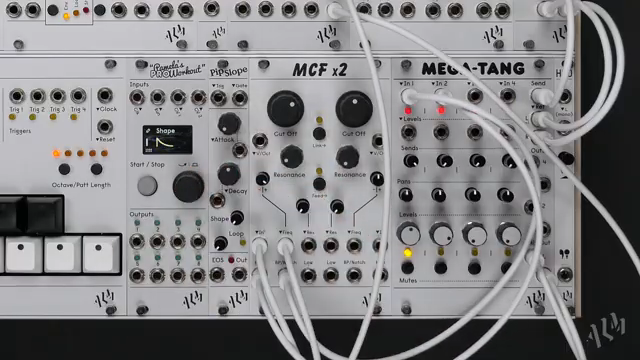
"Immediately resulting in a sound similar to water dripping."
© Screenshot/Quote: Busycircuits (YouTube)
From Structure to Chaos: Turismo’s Creative Range

"A wide range of processing options via the MFX programs and the possibilities of sampling and layering with the squid offer endless fun and exploration in less conventional patches."
© Screenshot/Quote: Busycircuits (YouTube)
With all elements in place, the Turismo demonstrates its ability to move seamlessly from structured, sequenced music to freeform, experimental soundscapes. The system’s wealth of modulation options, utilities, and control voltage inputs make it a playground for sonic exploration.
ALM TV closes by emphasizing the endless creative potential of the Turismo—not just for beats and grooves, but for any patcher looking to blur the line between synthesis and the sounds of the real world. Whether you’re after a thunderstorm, a field recording simulation, or something entirely alien, the Turismo stands ready to oblige.
This article is also available in German. Read it here: https://synthmagazin.at/alm-tvs-turismo-sturmsynthese-im-modularsystem/
Watch on YouTube:
Latest articles
Watch on YouTube:
Visit the channel:
https://www.youtube.com/busycircuits
https://www.youtube.com/busycircuits
Links from busycircuits:
website: https://busycircuits.com
instagram: https://instagram.com/busycircuits
soundcloud: https://soundcloud.com/busycircuits
Sponsored links:
If you purchase via these links, we may earn a small commission – at no extra cost to you. The link opens an Amazon keyword search, and results may vary depending on availability.
Malt
🔗 Check price on Amazon
🔗 Check price on Amazon
MCF x2
🔗 Check price on Amazon
🔗 Check price on Amazon
Megamilton
🔗 Check price on Amazon
🔗 Check price on Amazon
Megatang
🔗 Check price on Amazon
🔗 Check price on Amazon
Pan Pro
🔗 Check price on Amazon
🔗 Check price on Amazon
Quaid Mega Slope
🔗 Check price on Amazon
🔗 Check price on Amazon
Sizzle
🔗 Check price on Amazon
🔗 Check price on Amazon
Tasm O
🔗 Check price on Amazon
🔗 Check price on Amazon
Turismo
🔗 Check price on Amazon
🔗 Check price on Amazon